Sunday, 31 July 2016

The Problem with Mr Taleb - Antifragile Review


In Antifragule, the economist, philosopher and options-trader Nassim Nicholas Taleb sets out to articulate the principles of "that which gains from disorder". Along the way he discusses a number of other topics, such as iatrogenics and the importance of acknowledging our inability to plan for black swans. There is a varying level of originality in the book's observations - the principle of planning while keeping unpredictability in mind is a fairly old one. In saying that, conceptualising unpredictability as an engine for growth may actually be a new idea.  Even the unoriginal points that Taleb expounds on, highlight ideas that don't received a lot of public attention so Taleb's mentioning of them is still quite welcomed.

The most contentious parts of Antifragile are found in the sections where Taleb argues that academic research comes after, not before, human progress has been made. The tinkerers shall inherit the earth, the nerds know nothing. New medicines are "discovered" by private firms far more often than in publically funded laboratories (p.231), and we should take note of the huge technological innovation that happens in the playground of Silicon Valley (p.42). The question as to whether private firms simply patent/develop more variations of already existent drugs, as opposed to discovering new ones, is left unexplored; as is the tech industry's infamous reliance on publically funded research programs to develop their gadgets. Outside of that, the brash and aggressive writing style, that Taleb is known for, is very prominent. Almost every negative review I have read of Taleb's work mentions his preening arrogance and even the positive reviews often concede this point. Initially, I wanted to conduct a review of Antifragile that didn't dissect his personality. Alas, I have found that to be a difficult task, if only because so much of Antifragile attempts to communicate Taleb's vision of himself.

There is a clear and carefully curated persona on display: Taleb is a cultured, wine drinking, straight talking, poetry loving, power lifter. He is a lone wolf - uninterested in your awards and approval. He tells it like it is. He is streetwise, well-read and cultured, but under no circumstances to be thought of as a nerd. Taleb is manly and brave. Taleb is a man of action, not like those other scholars with their spectacles and atrophied muscle. On its own, this kind of chest-thumping would be a mere annoyance, inconsequential to the quality of the scholar's work; unfortunately, it seems it has bled into the content of Taleb's writing, to the detriment of his argument's credibility.    

Consider Taleb's chapter on the ethics of risk taking. The ethics section of Antifragile lays out a maxim for moral behaviour that focuses on keeping the collateral of risks limited to those who volunteer their own skin. People who risk their own good for others, are heroes; those who risk their own good for their own gain, are passable humans and those who risk others for their own gain, are villains - according to Taleb. To elucidate on the consequences of this moral outlook, Taleb handily provides  us with a table (p.377) which places various professions - artist, writer, businessman, soldier - into one of three columns. The columns are "no skin in the game" (bad), "skin in the game" (neutral) and "skin in the game for others sake" (good). The table however, seems somewhat arbitrary. For example: journalists who analyse and predict events are in the bad column, activists are neutral and rebels and revolutionaries are good.

Why are journalists bad, but activists neutral when both seek to predict and comment on society? It is true that we rarely hold journalists accountable for their failed predictions, but we hold activists accountable even less. A journalist risks embarrassing themself on a public stage; conversely, most activists are voices in an otherwise anonymous crowd. The only real difference between the two is respectability, but that is a matter of scale and Taleb's claim is that there is something qualitatively different in the way they externalise risks. Furthermore why on earth would Taleb place revolutionaries automatically in the good column? Revolutionaries may believe that good things await everyone in the coming social order but the consequences of failed revolutions are well documented. We have every reason to think that the revolutionaries risk the wellbeing of everyone not just themselves - this is precisely the kind of behaviour that Taleb supposedly repudiates.

How then can we explain this bizarre ranking, inferred from the table, that revolutionaries are the most virtuous risk takers when compared to activists and, certainly, in comparison to journalists? The answer is by appealing to Taleb's persona. Once we understand that revolutionaries, activists and journalists are not being ranked in accordance with their management of risks but rather in relation to a warrior/scholar archetype that Taleb identifies with, then the ranking starts to make more sense. Journalists are effete, sheltered members of the establishment; activists are scrappy underdogs but revolutionaries, the most macho of the three, fight wars and topple governments - they are, in Taleb's eyes, the most worthy of respect.

The irony is that Taleb's approach to ethics is, on the whole, quite plausible. I may have my doubts about it, I am not certain that we can ever really take risks entirely on our own, but it is a valid approach to doing ethics in an uncertain world. This is exactly what I mean when I say that Antifragile is a solid work burdened with poor and distracting set-dressing. Antifragile provides plenty of novel angles to work from, but their value is obscured by its author's desperation to be thought of as a scholarly mafioso.

While Taleb is smart enough to know that he should only allude to the mafia-like qualities of his persona, Mafia bosses are referenced to as exemplars of his observations (p.43). And late in the book Taleb makes the more bizarre claim that mafia dons have a form of honour that escapes contemporary leaders (p.376), in so far as Mafia bosses are the most likely to be whacked- or so goes Taleb's account of organised crime. Naturally this is nonsense. Even a casual reader can tell you that frequently the first to die in any given drug-war are the low-level dealers, and that criminal conspiracies are usually orchestrated to leave the higher-ups untouchable, if it all goes wrong. The crime-barons sit safe in their mansions reaping the dividends of their empire, while the youngsters, eager to prove themselves, are left with the dirty, dangerous and incriminating footwork on which the empire is built. The reality is the opposite of what Taleb thinks it to be, but the grim glamour of the macho mafia-don archetype sells it to Taleb and glosses over the lack of veracity.

Taleb, towards the end of the book, also advises readers to think for themselves and savages those who use the opinion of others to gather knowledge about the world (p.419-20), not long after defending tradition (p.257) and advising the reader to prioritise useful heuristics over abstract truth seeking. This is also ignoring that conformity itself is a heuristic. The behaviours and thoughts of others are an excellent resource for selecting a strategy in times of uncertainty. The gazelle that stops to ask "Why am I running just because everyone else is running?" is destined to become lion chow. Taleb thinks of himself as a street-wise "doer" concerned with what works over what is true, but also wants to be the principled, sceptical upstart - not realising that often these two ways of seeing the world come into conflict and that he needs to be much more flexible if he wants to mesh the two ways of thinking.

Most of these problems are just a result of Taleb's romanticised aesthetic crashing against the more reasoned parts of the book: blips of momentary incongruence generated by Taleb's posing as a refined, street-smart, independent scholar. When you step back from these blemishes you find that they are mostly negligible. Antifragile is still an interesting book and well worth reading. What is infuriating however, and what I have been trying to get across here, is that while Taleb may have convinced himself that his opponents are just stooges for the academic orthodox, it may be that the biggest thing standing in the way of Antifragile's credibility, is Mr Taleb himself.    

Wednesday, 1 June 2016

The 2016 Half Time Review


With the arrival of June comes this year's edition of Cut-throat and Clueless' Half-Time Review. As you might have noticed, I have half-finished redesigning this blog in celebration of this milestone. For my original list of 2016 resolutions click here, and for my last quarterly review click here. Below is a summary of victories and setbacks that have been achieved and/or suffered over the last three months.


Resolutions.


1. Reading, Writing, Running.

My reading has picked up its pace since I last discussed my resolutions on this blog; my writing has been steady, though mostly fiction orientated, and my exercise regime has finally diversified to include body-weight training - routines that once reduced me to a huffing mess, I now breeze through effortlessly and it feels great! I have also recently booked myself onto a distance learning course with the UK Society for Editors and Proof-Readers - I'm looking forward to it immensely. I also have my first Judo session, in years, coming up at the end of this week.

2. Get Techie.

Hurrah for progress! I have finally started learning Python and it's fascinating. Coding engages a very different part of my brain to that which is engaged when reading and writing philosophy. Frankly I'm excited to learn something tech related but also hoping to gleam some of the mental benefits associated with programming. Granted the few hours I have put in so far were grinded out purely so I'd have something to write here, but the enjoyment I have received from it has been genuine.   

I'll have to find some sort of project to focus on later in the year, at the moment I'm just trying to memorise the basics.


3. Get Foodie.

There has been too much progress made here to list comprehensively. Notable success' include home-made pizza made from scratch; vegetable pakora and a couple of other great finds discovered among my growing collection of cookery and cocktail books. I'm making food better, faster and with less stress than ever before. As a side note, I've discovered that food and drink books are remarkably reflective of their social origins.


Consider that "The Savoy Cocktail Book" written by Harry Craddock back in the 1930's is close to 300 pages long with almost every page containing  4 or 5 recipes, each of them calling for a variety of spirits and liquers. By contrast, "Good Things to Drink" written by Mr Lyan, and published last year, features recipes that tend to focus on one particular spirit and prefers the intelligent use of mixers and garnish to accompany drinks. In terms of "recipes per page", it has one recipe for every couple of pages with the majority of the book being photos of Mr Lyan and his friends drinking in rustic locations while looking infuriatingly hip.


This is the unfortunate consequence of modern advertising, and caused by the same forces that have perfume companies advertising with bizzare montages of models sliding out of Limos. While Craddock may bring content by the bucket-load, Mr Lyan would trounce him in terms of sales if they ever competed - the gloss sells.

Gripes aside, as much as I have enjoyed Mr Lyan's book, he has a bad habit of tacking "top up with champagne" onto the end of his recipes; the fact that he considers adding champagne to be an afterthought indicates that mixology has yet to escape its privileged roots.


Sunday, 29 May 2016

Thoughts on: Feminism, Eudemonia and The Philosophical Life.


Modern philosophy is an academic institution, not a way of life. This contrasts with its earlier reification where academies were far more reminiscent of religious sects than they were modern universities. Early philosophers, like the Stoics and Cynics, lived in communities that pursued eudemonia, a state of being attained through practise as often as it was through contemplation. Modern philosophy, by contrast, takes place in specialised university departments and is abstract, highly disciplined - motivated by a pay-check.*

This split between modern and ancient philosophical practises is partly a product of modern philosophy's formulation within academia, and particularly its formation within the context of scholarly specialisation. The early-modern demarcation of Natural Philosophy from Mental Philosophy, that gave birth to modern science, gave cause for philosophers to specify their role in relation to the newly emerging sciences. This is where the tradition of Analytic philosophy comes in to play. The Analytic school, often ambiguously referred to as the hand-maiden to science, championed a detached methodology intended to work in tandem with modern empiricism. It was a school of thought that initially went hand in hand with logical positivism and ultimately weathered many of the same criticisms.  Modelling themselves on the impartiality of science, Analytic philosophers embraced a rationalist methodology that emulated scientific values and aesthetics. 

But Moral and Ethical Philosophy, in particular, produce a form of discourse that is decidedly partial. Ethics makes up a large chunk of philosophy both in the disciplinary form of "Applied Ethics" and in the earlier more holistic sense of  eudemonia. It is a subject that asks us to change the way we interact with the world, which is distinct from scientific endeavours which are decidedly descriptive. Just as science and religion are often thought to be irreconcilable, so too are science and normativity. Analytically influenced ethicists have traditionally tried to resolve this idealistic tension by offering a form of philosophy that reads more like the prouct of an advisory panel than it does the outpouring an empassioned exemplar of human virtue.

Of course, despite the professional gloss, there are a number of analytic philosophers who have a personal stake in the arguments they present. Of particular interest are the feminists and their radical off-shoots who promote the interrogation of our preconceptions and celebrate conscious personal change. The rhetoric and literature surrounding identity politics, for example, often calls into question our ability to freely and objectively perceive others. Scepticism as a way of life then returns. Are female writers producing art that is less universal, and therefore less popular, or is their work simply not taken as seriously? Do I like masculine activities because I'm a man, or because I've been socialised to prefer them?

Within modern feminist praxis, and we'll limit ourselves to feminism for now, there is a continuation of early personal and transformative philosophy. A mode of philosophising where participants are invited to change their behaviour and interrogate their own perceptions of the world in pursuit of justice. The older notion of philosophical community can also be found in the modern concept of the affinity group: a collection of individuals who form relationships on the basis of their shared political affiliations.

In this way, the modern intersectional left has inherited the practise of philosophy as a critical approach to good living. Continental philosophy also, particularly Foucault, seems to have a strong tradition of practising philosophy with the intent to liberate. Once again leftism is a big part of that tradition: if only because the philosophical outlook tends to lend itself better to political outsiders than it does to members of the establishment. Outside of this there is a small cottage industry of pop-philosophy writers who aim to keep the transformative tradition of philosophy alive without getting too political. Susan Neiman, a Kantian ethicist, wrote a great book that I reviewed on this blog a while back; Alain De Botton continues to peddle his "Ways philosophy will heal/change you" shtick but a more recent book that I read on the subject was Prof James Miller's "The Philosophical Life".

Miller's book is a series of mini-biographies of famous philosophers throughout the ages. It is presented in the hope that these biographies will help revive the notion of philosophy as a way of life. The book's blurb boasts that it, "confirm[s] the continuing relevance of philosophy today", but what's notable about "The Philosophical Life" is that the most contemporary philosopher dissected is Nietzsche - a man who died over a century ago.

There is a strain of transformative philosophy alive today, but I wonder if its ideas are too contentious to be marketable outside the sphere of politics. Perhaps this sanitisation of transformative philosophy is what drives the critics of de Botton?  Eudemonia is intimately connected to ethics which is frequently bound up in political struggle. Attempting to secularise eudamonia may be what makes De Botton's writing seem so hollow; after-all, once you forgo the critique of your politico-economic reality, what's left outside of curmudgeonly Michael Foley stoicism?


* Okay, that last one was mean-spirited even it was, economically speaking, true.

Tuesday, 26 April 2016

Spectrums, Assumptions and The Political Compass


The left-right distinction is a well-worn feature of our political lexicon: a schema that finds its roots in revolutionary France and has since been abstracted out of context to typify politics tout-court.

A modern reader might reasonably wonder whether such a spectrum holds up considering the shades of left and right available to us. In our post-Reagan/Thatcher era the Right is torn between its roots in classical conservatism and the modern libertarianism that has attempted to replace it. The Left, similarly, is as fragmented in theory as it has been in practise. Consulting the conventional left-right dichotomy, we find anarchists and marxists in the same camp as liberals. While one might try to defend such a grouping on the grounds that a sliding scale could be plotted between communism and liberalism, this falls in to the trap of typifying socialism as "welfarism on steroids" while still failing to explain how anarchists tessellate with the left.

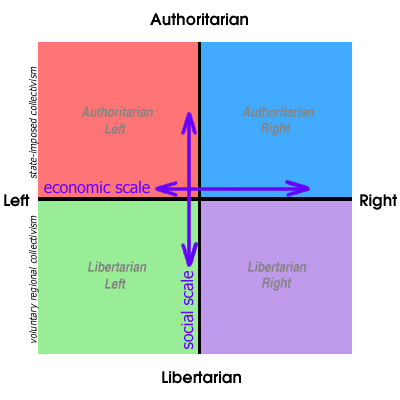
In response to such difficulties, alternative spectrums have been produced. In the late 60's David Nolan introduced a spectrum which simultaneously charted the  dimensions of economic and personal freedom: the most prolific iteration of which is "The Political Compass".

Pictured: The Political Compass (below left) and Nolan's chart (below right).


cartesian plane with horizontal left-right axis and vertical authoritarian-libertarian axis


While this twin-variable approach does help clear up the difference between libertarianism and conservativism, the underlying meta-theory is still lacking. Nolan's divide between economic and personal freedom reflects his own libertarian tendency to understand freedom from and freedom to as distinct categories - with the former taking moral primacy. Here freedom is reified and frustrated independently of one's economic means: your liberty can be obstructed by a tyrannical government but not by economic deprivation - this is only one way of understanding freedom.

Concurrently there is a problem as both The Political Compass' and Nolan assume that competing ideologies maintain converging ideas of what freedom and equality etc entail. Consider, for example, The Political Compass' analysis of anarchism:  

"The usual understanding of anarchism as a left wing ideology does not take into account the neo-liberal "anarchism" championed by the likes of Ayn Rand, Milton Friedman and America's Libertarian Party, which couples social Darwinian right-wing economics with liberal positions on most social issues."  - The Political Compass.

This places orthodox anarchism in the bottom left and "neo-liberal anarchism" in the bottom right. Such an approach misunderstands the disagreement between minarchists and anarchists as one over whether or not people should "share their stuff" and misses the fact that the two groups have very different ideas about what it means to be free. Libertarian leftists disagree with libertarian rightists because they do not consider the ideas of the libertarian right to be fit for promoting a fully "free" society - their economic differences inform their disagreements over the nature of libertarianism.

The problem facing any political spectrum then is the necessary assumption that political differences are mostly quantitative; which is troublesome considering that political questions are more often also about what a virtue is as well as how much of it we should have. Such spectrums, at best, chart the possibilities of pragmatic political alliance between various groupings but pedagogically do little to inform test-takers about how their beliefs relate to others.