Showing posts with label Anarchism. Show all posts

Tuesday, 26 April 2016

Spectrums, Assumptions and The Political Compass


The left-right distinction is a well-worn feature of our political lexicon: a schema that finds its roots in revolutionary France and has since been abstracted out of context to typify politics tout-court.

A modern reader might reasonably wonder whether such a spectrum holds up considering the shades of left and right available to us. In our post-Reagan/Thatcher era the Right is torn between its roots in classical conservatism and the modern libertarianism that has attempted to replace it. The Left, similarly, is as fragmented in theory as it has been in practise. Consulting the conventional left-right dichotomy, we find anarchists and marxists in the same camp as liberals. While one might try to defend such a grouping on the grounds that a sliding scale could be plotted between communism and liberalism, this falls in to the trap of typifying socialism as "welfarism on steroids" while still failing to explain how anarchists tessellate with the left.

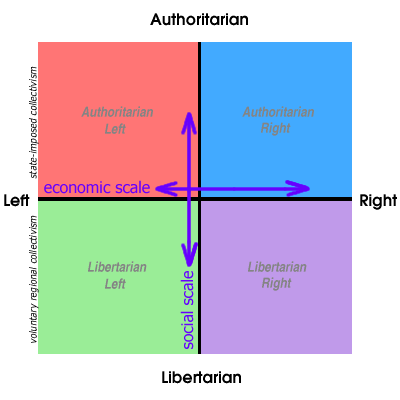
In response to such difficulties, alternative spectrums have been produced. In the late 60's David Nolan introduced a spectrum which simultaneously charted the  dimensions of economic and personal freedom: the most prolific iteration of which is "The Political Compass".

Pictured: The Political Compass (below left) and Nolan's chart (below right).


cartesian plane with horizontal left-right axis and vertical authoritarian-libertarian axis


While this twin-variable approach does help clear up the difference between libertarianism and conservativism, the underlying meta-theory is still lacking. Nolan's divide between economic and personal freedom reflects his own libertarian tendency to understand freedom from and freedom to as distinct categories - with the former taking moral primacy. Here freedom is reified and frustrated independently of one's economic means: your liberty can be obstructed by a tyrannical government but not by economic deprivation - this is only one way of understanding freedom.

Concurrently there is a problem as both The Political Compass' and Nolan assume that competing ideologies maintain converging ideas of what freedom and equality etc entail. Consider, for example, The Political Compass' analysis of anarchism:  

"The usual understanding of anarchism as a left wing ideology does not take into account the neo-liberal "anarchism" championed by the likes of Ayn Rand, Milton Friedman and America's Libertarian Party, which couples social Darwinian right-wing economics with liberal positions on most social issues."  - The Political Compass.

This places orthodox anarchism in the bottom left and "neo-liberal anarchism" in the bottom right. Such an approach misunderstands the disagreement between minarchists and anarchists as one over whether or not people should "share their stuff" and misses the fact that the two groups have very different ideas about what it means to be free. Libertarian leftists disagree with libertarian rightists because they do not consider the ideas of the libertarian right to be fit for promoting a fully "free" society - their economic differences inform their disagreements over the nature of libertarianism.

The problem facing any political spectrum then is the necessary assumption that political differences are mostly quantitative; which is troublesome considering that political questions are more often also about what a virtue is as well as how much of it we should have. Such spectrums, at best, chart the possibilities of pragmatic political alliance between various groupings but pedagogically do little to inform test-takers about how their beliefs relate to others.


Friday, 29 January 2016

Brief Thoughts: Rousseau's Social Contract.


Rousseau's shadow history is that of an unwitting proto-apologist for 20th century authoritarianism. Considering this, how much of his work is salvageable from an anti-authoritarian standpoint?

To be clear, his idealism is frighteningly Orwellian. Most worrying is his concept of the sovereign will: a justification for a perfectly paternalistic government that enforces laws in the knowledge that, despite any individual protests, it really has everyone's interests at heart. The abstract notion of a perfect righteous governtment is itself not so troubling, more-so the fact that Rousseau thinks that such an institution is worth attempting to emulate in an imperfect concrete world. A quote by Vaclav Havel springs to mind:


"[There is] a direct and logical progression from beautiful utopias to concentration camps... [which are] ...but an attempt of utopians to dispose of those elements which do not fit into their utopias" - Havel quoted in John P. Clark's "The Impossible Community: Realizing Communitarian Anarchism" p. 131.


However, to view The Social Contract from this angle alone neglects the other points in his work where Rousseau acts as a pre-configuration of later left libertarian ideas.

For all its naivety, the book contains a number of perspicacious observations which still prevail in contemporary political thought. For instance, the noted distinction between socially constructed civil liberty and the baser, more solipsistic, "natural liberty". This distinction, which is nonetheless considered by its detractors a pernicious one that foists too much work on the shoulders of liberty resulting only in perversion, has had an explicit influence on the work of participatory democrats and finds many other parallels in anarchist thought.  

Other notable themes of contemporary interest are Rousseau's delineations of  the economic and political conditions necessary for wide-spread direct democracy and his post-classical interpretation of democratic subjects. Radical egalitarians, especially those with a love of democratic institutions, have often been quick to emphasise the incompatibility of inequality of wealth with harmonious and stable democratic arrangements. This is true for both for participatory democrats and for anarchists: though anarchists don't often argue for the harmony of egalitarianism via an explicitly democratic teleology. 

The "post-classical democratic subject", typically a response invoked to explain humans who are ambivalent to increases in their own access to democracy and liberty, is present and considered here:


"Aristotle was right; but he mistook the effect for the cause. Anyone born in slavery is born for slavery - nothing is more certain. Slaves in their bondage, lose everything, even the desire to be free." Rousseau, The Social Contract p.51-52


And a call for a revision of the classical political subject, which Rousseau's analysis is an early answer to, is found in Saul Newman's "The Politics of Post-Anarchism":


The crucial question raised by Deleuze and Guattari - "how can desire desire its own repression...?" - confronts all radical politics with a central ambiguity. The classical anarchists were not unaware of this problem; indeed, Kropotkin attributes the rise of the modern state in part to people becoming "enamoured of authority" and to their self-enslavement to increasingly centralised systems of law and punishment. However, this problem, while acknowledged, was not sufficiently addressed or theorised in anarchism. Yet it creates certain obvious difficulties for anti-authoritarian politics, unsettling the notion of the moral and rational agent who revolts against an immoral and irrational power.  - Saul Newman in "The Politics of Post-Anarchism" p.60 


So despite their notoriety Rousseau's ideas still have some currency: or at least there are ideas in his political philosophy that are not so offensive that anti-authoritarians discard them out of hand. That said, how do we separate the libratory Rousseau from the tyrannical Rousseau? Where does the problem lie, precisely?

The primary culprit would seem to be his uncritical endorsement of majoratarianism vindicated through his abstract soveriegn will. Rousseau's trust in the sovereign will excludes the possibility of it being usurped by interest groups or becoming exploitative of persistent minorities. Perhaps possibilities of abstention and conscientious objection, along with a greater cynicism towards majoritarianism and the power structures of the state, could render him more palatable?

Indeed modern liberatory writers who adopt his ideas are often markedly unanimous in their avoidance of the problematic concept of sovereign will, even while borrowing from the rest of his political canon. It seems while Rousseau's rhetoric is in places an unfortunate overture to the brutal regimes of the last century, many anti-authoritarians still owe him a philosophical debt. 

Friday, 24 July 2015

"Rethinking Democracy" By Carol Gould: First Thoughts On Reading


 It is a tragedy that this kind of political philosophy is so overlooked. Carol Gould is one of the few authors out there who takes democracy seriously enough to construct a theory from it, and yet her work is often missed when reviewing the literature. Despite the fidelity of Gould's work to the democratic project she barely makes it into the democracy entry on the Stanford Encyclopaedia of Philosophy except as a foot-note. In fact the theories of democracy that are touched on in the SEP are largely restricted to liberal, neo-liberal and aristo-monarchic positions.

So why has the work of Gould and her peers been so ignored?

Personally I think the problem lies with its ambigious classification and heritage. The arguments that Gould offers are too radical to fit in with the liberalism of Rawls and Dahl yet too reformist to be discussed alongside Anarchism. Furthermore, theories of participatory democratic theory are so multifaceted in terms of their origins that it is very difficult to slot them into one singular account of modern democratic theory, ergo they are often left out. 


Pragmatically speaking, this kind of book would be very informative for those interested in anarchism: in so far as it delineates an actual modus operandi for future "liberated territories". While Gould does retain both the state and the market as methods of organisation they are so augmented by the time she re-formulates them that they can barely be considered to be the kind of things that anarchists rail against. Her view of a democratic economy, for instance, largely mirrors anarcho-syndicalism (though it is never described in such terms) and her approach to governance consists of bottom up participatory structures. In short, the market that Gould wants is a socialist one and the territorial governance that she envisions needs little tweaking to defy conventional anarchist critiques.

It's not all one way traffic though. Gould's model of democracy could learn a few things from anarchism vis-a-vis institutional practises. Her vision of democratic participation, the actual making of decisions, seems to be focused on conversations followed by, what one would assume to be, a majority vote. Her theory's defence against majoritarian tyranny and persistent minorities is simply an appeal to the democratic character of its subjects. The anarchist tradition could offer here both a model of consensus decision making and an emphasis on decentralisation in order to build a more robust systemic response to the various upsets that can result from majority rule.

The social ontology and the ethical underpinnings of her theory remind me of Susan Neiman's "Why Grow Up?": at its core there's a really invigorating vision of humans as creative beings seeking self-betterment. In line with this, the book's content rests on a moral conception of self-determination as a requirement for human self-development. Gould rejects both liberal individualism and socialistic holism for an intermediate ontology that views humans as individuals whose identities are understood, pursued and realised through social relationships.


In terms of economic justice, this social ontology provides her with a twin pronged attack. If the purpose of freedom is self-development then this defends both "welfarism" and worker control of the means of production. "Welfarism" is justified on the grounds that everyone is entitled, where possible, to the resources that make self-development possible and the "rights to worker control" become justified where work is a social activity in which self-development takes place.

The book is strikingly comprehensive. "Rethinking Democracy" deals with topics as varied and concrete as the relationship between freedom and equality; the role of technical expertise in participatory democracy,  and the consequences Gould's theory has for debates surrounding global interventionism. If you want an idea of how anarchist principles might play out in a future society, but can't stand the more tendentious elements of anarchist rhetoric, then this is a worthwhile read.