Showing posts with label Libertarianism. Show all posts

Tuesday, 26 April 2016

Spectrums, Assumptions and The Political Compass


The left-right distinction is a well-worn feature of our political lexicon: a schema that finds its roots in revolutionary France and has since been abstracted out of context to typify politics tout-court.

A modern reader might reasonably wonder whether such a spectrum holds up considering the shades of left and right available to us. In our post-Reagan/Thatcher era the Right is torn between its roots in classical conservatism and the modern libertarianism that has attempted to replace it. The Left, similarly, is as fragmented in theory as it has been in practise. Consulting the conventional left-right dichotomy, we find anarchists and marxists in the same camp as liberals. While one might try to defend such a grouping on the grounds that a sliding scale could be plotted between communism and liberalism, this falls in to the trap of typifying socialism as "welfarism on steroids" while still failing to explain how anarchists tessellate with the left.

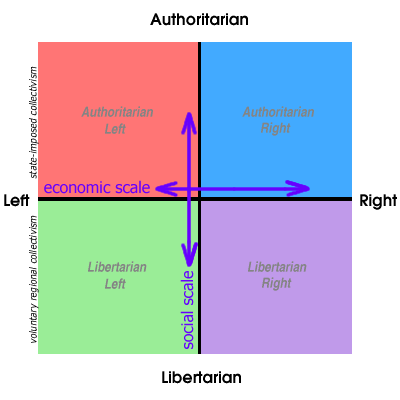
In response to such difficulties, alternative spectrums have been produced. In the late 60's David Nolan introduced a spectrum which simultaneously charted the  dimensions of economic and personal freedom: the most prolific iteration of which is "The Political Compass".

Pictured: The Political Compass (below left) and Nolan's chart (below right).


cartesian plane with horizontal left-right axis and vertical authoritarian-libertarian axis


While this twin-variable approach does help clear up the difference between libertarianism and conservativism, the underlying meta-theory is still lacking. Nolan's divide between economic and personal freedom reflects his own libertarian tendency to understand freedom from and freedom to as distinct categories - with the former taking moral primacy. Here freedom is reified and frustrated independently of one's economic means: your liberty can be obstructed by a tyrannical government but not by economic deprivation - this is only one way of understanding freedom.

Concurrently there is a problem as both The Political Compass' and Nolan assume that competing ideologies maintain converging ideas of what freedom and equality etc entail. Consider, for example, The Political Compass' analysis of anarchism:  

"The usual understanding of anarchism as a left wing ideology does not take into account the neo-liberal "anarchism" championed by the likes of Ayn Rand, Milton Friedman and America's Libertarian Party, which couples social Darwinian right-wing economics with liberal positions on most social issues."  - The Political Compass.

This places orthodox anarchism in the bottom left and "neo-liberal anarchism" in the bottom right. Such an approach misunderstands the disagreement between minarchists and anarchists as one over whether or not people should "share their stuff" and misses the fact that the two groups have very different ideas about what it means to be free. Libertarian leftists disagree with libertarian rightists because they do not consider the ideas of the libertarian right to be fit for promoting a fully "free" society - their economic differences inform their disagreements over the nature of libertarianism.

The problem facing any political spectrum then is the necessary assumption that political differences are mostly quantitative; which is troublesome considering that political questions are more often also about what a virtue is as well as how much of it we should have. Such spectrums, at best, chart the possibilities of pragmatic political alliance between various groupings but pedagogically do little to inform test-takers about how their beliefs relate to others.


Thursday, 8 January 2015

Strange Bedfellows: Freedom, Equality and Love.


"Liberte, Egalite, Fraternite" is the phrase that I once had planned to have tattoo-ed above my heart. That was until I found out it was the motto of France and decided there was something a bit weird about adopting French nationalism having never so much as set foot on French soil.

Digressions aside this little trinity of values, freedom/equality/fraternity, has proved to be a slippery customer for many a political philosopher despite them being the presumed corner-stone of liberal thought. Humans ought to be free, Humans are naturally equal and Humans should strive for a world of love and togetherness. It all sounds rather idealistic and lovely and to be fair when you hear modern advocates of liberalism discuss them, even in a dry academic context, you can't help but fall in love with them.
 
So where's the problem? What makes this homely triplet so slippery to grasp?

 The crux of it lies in slotting together the ideals of equality and freedom. The argument being that some people naturally are more talented, deserving, resourceful or driven than others and in a society where everyone is free to pursue success and prosperity this makes equality impossible.
Indeed certain philosophers have turned their backs on liberalism for precisely this reason. The libertarian poster boy Friedrich Hayek in "The Constitution of Liberty" keeps his endorsement of equality firmly chained to the backseat, allowing for nothing but "equality before the law".* Where as Roger Scruton, a man of a more traditionally conservative bent, quite early on in his book "The Meaning of Conservatism" argues that the fundamental flaw, right from the beginning of the liberal project, was in thinking that any form of equality could be reconciled with freedom .**

Coming from a political background that is distinctly "anti-liberal" I'm going to attempt to offer a solution to this problem.

Both the terms equality and freedom pull on us and rightly so. They describe conditions of life that most of us, raging ego-maniacs aside, would consider to be quite pleasant.

The problem that liberalism has, and concurrently the problem with the phrase "liberte egalite fraternite", is that it mistakenly suggests that equality and freedom describe two distinct values when in reality they describe the very same project but from different qualitative angles.

In liberal language, freedom is thought of as an individualist value; it is something that exists independently of society and indeed it is almost defined by a lack of influence from society. Accordingly, to prevent this giddy Icarus of self-determination from flying into the sun of tyranny, liberalism tempers it with equality and also fraternity. In short equality works to restrict freedom enough so that it is socially tolerable.
My instinct when presented with these kinds of dichotomies is to assume that we are talking about these values incorrectly rather than failing to achieve the right balance. So here's my assessment in full:

Where as freedom describes the lived experience of acting on ones desires, equality describes the social conditions necessary for freedom to be realized as a political ideal. In short we must be equal or else we have not achieved freedom in the meaningful political sense and conversely if we are not free then we cannot be equal.

One may be tempted to argue that one can be equal and not free just as one can be free and not equal; usually by drawing on a hypothetical society in which everyone was forced to have the same amount of resources or alternatively pointing to the old Soviet Union.

However, in order for someone to take away your freedom they must have power over you. If your fellow man is truly your equal then they would not be able to strip you of your freedom. Unequal societies cannot play host to true political freedom as the freedom of those lower down the social ladder is conditional on the approval of those higher up.

Likewise if your freedom can be unjustly restricted then there must be someone in a position of power who can command you, hence inequality.

The problem with having "liberte and egalite" in the same sentence is not that they are antagonistic but rather that it is a mistake to conceive of them as separate projects.


*For now we're just going to forget that libertarians are, at heart, classical liberals and that there are probably plenty of early liberals who would of accepted Friedman's approach to equality.

** Scruton actually does have some interesting things to say about Fraternity, in particular its potentially suffocating nature, with regards to freedom, when it turns into full-blown communitarianism.