Showing posts with label Political Philosophy. Show all posts

Tuesday, 15 November 2016

On Democracy and Its Cynics: Reflections on Trump

The presidential election of the United States of America 2016 transpired just under a week ago and now every person of every sensible shade of political opinion is shaking their head in disbelief. Naturally, the electoral victory of such a ruinous candidate as Trump has resulted in some bitter reflection on the values and limitations of democracy (examples of this anxiety/bitterness in pre-election form are found: here and here). The criticisms now are largely the same as those raised in times of yore: most voters are ignorant and, in an electoral democracy, charismatic leaders will often outperform more competent candidates. These points are echoed throughout the history of political philosophy from Plato's Republic to the "elite theorists" of democracy of the 50's, and they are given plenty of air time in times of distress. It is then only natural that we see them aired once more.

                                     Image result for Trump business

We must remember that Trump is/was far from being a typical electoral candidate. He himself is/was a member of the American Aristocracy. While he has solidified his power over the American landscape through an electoral victory, he was always a wealthy and connected member of the American plutocracy nonetheless. Had there been no election to win, were the United States of America a Neo-Roman Republic or Empire, Trump would probably have ascended to power just as easily through Machiavellian real-politick. In the hypothetical alternative universe of the United States of Aristocracy, he would have assassinated and out-manoeuvred his rivals just as he stampeded them in our democratic one. Authoritarian organisations typically favour rather than stifle the Caligula-esque figures such as Trump, but what of technocracy: the rule of the competent and wise? Is technocracy not a suitable alternative model; one that could avert the horrors of capriciously unscrupulous demagogues, without providing a power structure that would enable the reign of tyrants?


Thankfully, most people in the west are inclined to agree with Churchill and his the summation of democracy as "...the worst form of government, except all those others forms that have been tried from time to time.". The paradoxical nature of our contemporary democratic cynicism is worth unpacking. We loath democracy's nominal flaws, even though we recognise that it has value. But what would we possibly replace it with? Voters are often uninformed and irrational but un-democratic leaders are rarely renowned for their reasonableness; and while demagogues may rise to power through electoral means, are such figures truly contained in more feudal or aristocratic societies?


The problem of technocracy, especially with regards to its conception in juxtaposition to democracy, concerns two key contentious claims which simmer beneath the surface.


First we must consider that technocracy and aristocracy are more closely related than we might first think. Aristocrats have always thought themselves to be technocrats - the literal translation of aristocracy is, after all, "rule of the best". The dialogues of western academies are mostly filled with the voices of rich, white men. A strategy of deferring policy decisions to relevant captains of research and industry would result in a very limited demographic being handed control; granted that demographic would be relatively well educated and worldly, but that has generally held true for all aristocracies whose histories are filled with examples of neglectful and myopic governance. This is not to say that a nominal technocracy would not be an improvement on aristocracy, but rather to add a pessimistic footnote that calls attention to the parallels technocracy and aristocracy share in struggling to provide fair and attentive governance.


Second, we must dispute the very foundation upon which the technocratic/democratic divide rests. The pursuit of competent governance is not antithetical to the pursuit of a fair and representative governing processes. It is my belief, based upon a flexible and serious consideration of democratic praxis, that the hunt for social equity in the realm of social and political organisation is a great enhancer to our collective efficacy. In this humanist age the function of good government - whether that is taken as the management of people or a more anarchistic "organising of things" - is to aid in the running of a society conductive to the pursuit of happiness and justice. This telos is both universal and implicitly egalitarian. A full consideration of all the interests of any given fragmented society is required for any chance at realising such an aim. Democratic channels foster diversity of opinion and provide the possibility of levelling differences in power. This is an often overlooked yet deeply important element of the democratic process and one which aids us in our technocratic desire for competent and informed decision making. Political questions are often value-laden and only amicably resolved after much representative dialogue and exchange of perspective. The cold expert-veto-technocracy outlined above may be effecient when handling questions of truth but it is limited in so far as questions of policy are frequently linked with more collaborative inter-social projects of discerning what is just and fair.


Yet despite this, to understand the call for greater involvement of expert opinion as an un-democratic or "extra-democratic" call is to be fooled into maintaining a limited view of what democracy could be. One that, as we will see, is pernicious in a philosophical sense and perhaps even spiritually harmful to the democratic project.


There are plenty of ways to integrate expert knowledge into democratic culture. Consider the "mini-publics" of the deliberative democrats: small groups in which citizens, chosen for their representativeness of the larger concerned population, gather together to make large-scale policy decisions after being briefed by experts and given space for collective reflection on the topic. Although major legislative bodies have been hesitant to trust these mini-publics, the qualitative research on the topic is very promising. Furthermore, models of Sortitive Democracy provide other promising avenues for incorporating professional and worldly expertise into the democratic process by making eligibility for particular roles subject to qualifications and experience in the relevant area of policy. Even the bog-standard electoral system can be tweaked to produce better informed voters by improving services which pertain to public education.
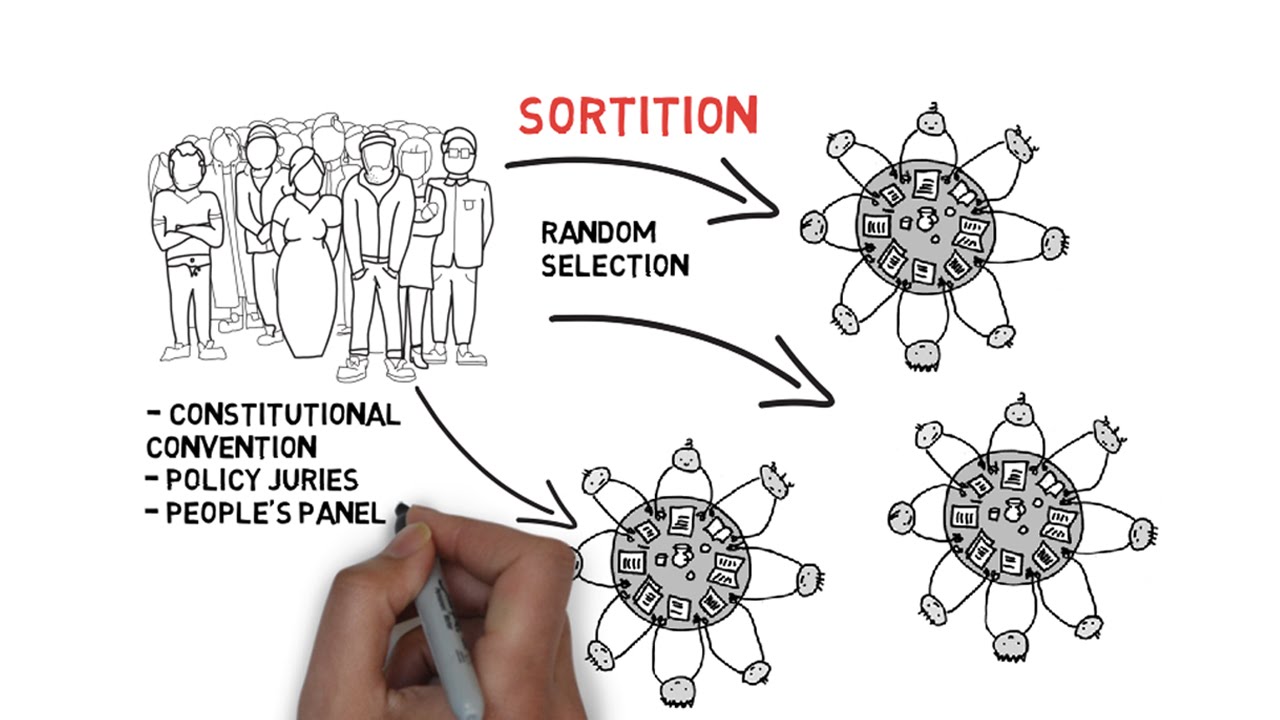

Image result for deliberative democracy Image result for sortition democracy


One might ask why I have bothered writing this post. After all, we all know that democracy really is the best of the worst, and none of us have any real desire to replace it. However I fear that our cynicism is both unwarranted and even dangerous. Democracy is not just a necessary arrangement to aid in the abatement of war-crimes and authoritarian collapse; it is a vessel which holds the seeds for a fairer and more intelligent world. Its invocation may not necessarily be a magical elixir to cure all ills, and it may require far more than a mere "going through the motions" to achieve anything worthwhile, but it is one of the moral zeniths of our modern age - however small, broken and disappointing it may seem to us now.


The ideals of democracy are far more institutionally flexible than they are often credited for. Democracy's core principles are firm, yet its praxis can easily be reworked to avoid the pitfalls of the dangerously populist and electorally obsessive systems of today. There are options for democrats who find the current formulations un-satisfactory; and there are steps that can be taken to improve and change it for the better. To portray democracy as a project doomed to produce Trump-like characters by way of unfortunate necessity is to limit our democratic sensibility and imagination: it is to tie our hands in the face of adversity rather than use this moment for reflection on the democratic failures of the current model and its attendant institutions.


In so far as Trump is a representative of an ignorant mass-hysteria coalesced around a cynical demagogue, he is also a representative of the deeply underdeveloped elements of American democracy. His triumph through the rallying of an un-communicative and ignorant public is but a indictment of the poor soil that has made up the substrate of U.S' voting public. In short, Trump is a poor leader in so far as he is the product of a poor democracy. The results of the 2016 election should not be a cause for empty despair at the supposed inefficacies of the democratic dream but rather a cause for reflection on the deeply under-developed potential of our democratic ideals and an affirmation of the steps that we must take to realise their humanistic, and even promethean, values.


Democracy is important: do not let the cynics discourage you.

Sunday, 31 July 2016

The Problem with Mr Taleb - Antifragile Review


In Antifragule, the economist, philosopher and options-trader Nassim Nicholas Taleb sets out to articulate the principles of "that which gains from disorder". Along the way he discusses a number of other topics, such as iatrogenics and the importance of acknowledging our inability to plan for black swans. There is a varying level of originality in the book's observations - the principle of planning while keeping unpredictability in mind is a fairly old one. In saying that, conceptualising unpredictability as an engine for growth may actually be a new idea.  Even the unoriginal points that Taleb expounds on, highlight ideas that don't received a lot of public attention so Taleb's mentioning of them is still quite welcomed.

The most contentious parts of Antifragile are found in the sections where Taleb argues that academic research comes after, not before, human progress has been made. The tinkerers shall inherit the earth, the nerds know nothing. New medicines are "discovered" by private firms far more often than in publically funded laboratories (p.231), and we should take note of the huge technological innovation that happens in the playground of Silicon Valley (p.42). The question as to whether private firms simply patent/develop more variations of already existent drugs, as opposed to discovering new ones, is left unexplored; as is the tech industry's infamous reliance on publically funded research programs to develop their gadgets. Outside of that, the brash and aggressive writing style, that Taleb is known for, is very prominent. Almost every negative review I have read of Taleb's work mentions his preening arrogance and even the positive reviews often concede this point. Initially, I wanted to conduct a review of Antifragile that didn't dissect his personality. Alas, I have found that to be a difficult task, if only because so much of Antifragile attempts to communicate Taleb's vision of himself.

There is a clear and carefully curated persona on display: Taleb is a cultured, wine drinking, straight talking, poetry loving, power lifter. He is a lone wolf - uninterested in your awards and approval. He tells it like it is. He is streetwise, well-read and cultured, but under no circumstances to be thought of as a nerd. Taleb is manly and brave. Taleb is a man of action, not like those other scholars with their spectacles and atrophied muscle. On its own, this kind of chest-thumping would be a mere annoyance, inconsequential to the quality of the scholar's work; unfortunately, it seems it has bled into the content of Taleb's writing, to the detriment of his argument's credibility.    

Consider Taleb's chapter on the ethics of risk taking. The ethics section of Antifragile lays out a maxim for moral behaviour that focuses on keeping the collateral of risks limited to those who volunteer their own skin. People who risk their own good for others, are heroes; those who risk their own good for their own gain, are passable humans and those who risk others for their own gain, are villains - according to Taleb. To elucidate on the consequences of this moral outlook, Taleb handily provides  us with a table (p.377) which places various professions - artist, writer, businessman, soldier - into one of three columns. The columns are "no skin in the game" (bad), "skin in the game" (neutral) and "skin in the game for others sake" (good). The table however, seems somewhat arbitrary. For example: journalists who analyse and predict events are in the bad column, activists are neutral and rebels and revolutionaries are good.

Why are journalists bad, but activists neutral when both seek to predict and comment on society? It is true that we rarely hold journalists accountable for their failed predictions, but we hold activists accountable even less. A journalist risks embarrassing themself on a public stage; conversely, most activists are voices in an otherwise anonymous crowd. The only real difference between the two is respectability, but that is a matter of scale and Taleb's claim is that there is something qualitatively different in the way they externalise risks. Furthermore why on earth would Taleb place revolutionaries automatically in the good column? Revolutionaries may believe that good things await everyone in the coming social order but the consequences of failed revolutions are well documented. We have every reason to think that the revolutionaries risk the wellbeing of everyone not just themselves - this is precisely the kind of behaviour that Taleb supposedly repudiates.

How then can we explain this bizarre ranking, inferred from the table, that revolutionaries are the most virtuous risk takers when compared to activists and, certainly, in comparison to journalists? The answer is by appealing to Taleb's persona. Once we understand that revolutionaries, activists and journalists are not being ranked in accordance with their management of risks but rather in relation to a warrior/scholar archetype that Taleb identifies with, then the ranking starts to make more sense. Journalists are effete, sheltered members of the establishment; activists are scrappy underdogs but revolutionaries, the most macho of the three, fight wars and topple governments - they are, in Taleb's eyes, the most worthy of respect.

The irony is that Taleb's approach to ethics is, on the whole, quite plausible. I may have my doubts about it, I am not certain that we can ever really take risks entirely on our own, but it is a valid approach to doing ethics in an uncertain world. This is exactly what I mean when I say that Antifragile is a solid work burdened with poor and distracting set-dressing. Antifragile provides plenty of novel angles to work from, but their value is obscured by its author's desperation to be thought of as a scholarly mafioso.

While Taleb is smart enough to know that he should only allude to the mafia-like qualities of his persona, Mafia bosses are referenced to as exemplars of his observations (p.43). And late in the book Taleb makes the more bizarre claim that mafia dons have a form of honour that escapes contemporary leaders (p.376), in so far as Mafia bosses are the most likely to be whacked- or so goes Taleb's account of organised crime. Naturally this is nonsense. Even a casual reader can tell you that frequently the first to die in any given drug-war are the low-level dealers, and that criminal conspiracies are usually orchestrated to leave the higher-ups untouchable, if it all goes wrong. The crime-barons sit safe in their mansions reaping the dividends of their empire, while the youngsters, eager to prove themselves, are left with the dirty, dangerous and incriminating footwork on which the empire is built. The reality is the opposite of what Taleb thinks it to be, but the grim glamour of the macho mafia-don archetype sells it to Taleb and glosses over the lack of veracity.

Taleb, towards the end of the book, also advises readers to think for themselves and savages those who use the opinion of others to gather knowledge about the world (p.419-20), not long after defending tradition (p.257) and advising the reader to prioritise useful heuristics over abstract truth seeking. This is also ignoring that conformity itself is a heuristic. The behaviours and thoughts of others are an excellent resource for selecting a strategy in times of uncertainty. The gazelle that stops to ask "Why am I running just because everyone else is running?" is destined to become lion chow. Taleb thinks of himself as a street-wise "doer" concerned with what works over what is true, but also wants to be the principled, sceptical upstart - not realising that often these two ways of seeing the world come into conflict and that he needs to be much more flexible if he wants to mesh the two ways of thinking.

Most of these problems are just a result of Taleb's romanticised aesthetic crashing against the more reasoned parts of the book: blips of momentary incongruence generated by Taleb's posing as a refined, street-smart, independent scholar. When you step back from these blemishes you find that they are mostly negligible. Antifragile is still an interesting book and well worth reading. What is infuriating however, and what I have been trying to get across here, is that while Taleb may have convinced himself that his opponents are just stooges for the academic orthodox, it may be that the biggest thing standing in the way of Antifragile's credibility, is Mr Taleb himself.    

Friday, 29 January 2016

Brief Thoughts: Rousseau's Social Contract.


Rousseau's shadow history is that of an unwitting proto-apologist for 20th century authoritarianism. Considering this, how much of his work is salvageable from an anti-authoritarian standpoint?

To be clear, his idealism is frighteningly Orwellian. Most worrying is his concept of the sovereign will: a justification for a perfectly paternalistic government that enforces laws in the knowledge that, despite any individual protests, it really has everyone's interests at heart. The abstract notion of a perfect righteous governtment is itself not so troubling, more-so the fact that Rousseau thinks that such an institution is worth attempting to emulate in an imperfect concrete world. A quote by Vaclav Havel springs to mind:


"[There is] a direct and logical progression from beautiful utopias to concentration camps... [which are] ...but an attempt of utopians to dispose of those elements which do not fit into their utopias" - Havel quoted in John P. Clark's "The Impossible Community: Realizing Communitarian Anarchism" p. 131.


However, to view The Social Contract from this angle alone neglects the other points in his work where Rousseau acts as a pre-configuration of later left libertarian ideas.

For all its naivety, the book contains a number of perspicacious observations which still prevail in contemporary political thought. For instance, the noted distinction between socially constructed civil liberty and the baser, more solipsistic, "natural liberty". This distinction, which is nonetheless considered by its detractors a pernicious one that foists too much work on the shoulders of liberty resulting only in perversion, has had an explicit influence on the work of participatory democrats and finds many other parallels in anarchist thought.  

Other notable themes of contemporary interest are Rousseau's delineations of  the economic and political conditions necessary for wide-spread direct democracy and his post-classical interpretation of democratic subjects. Radical egalitarians, especially those with a love of democratic institutions, have often been quick to emphasise the incompatibility of inequality of wealth with harmonious and stable democratic arrangements. This is true for both for participatory democrats and for anarchists: though anarchists don't often argue for the harmony of egalitarianism via an explicitly democratic teleology. 

The "post-classical democratic subject", typically a response invoked to explain humans who are ambivalent to increases in their own access to democracy and liberty, is present and considered here:


"Aristotle was right; but he mistook the effect for the cause. Anyone born in slavery is born for slavery - nothing is more certain. Slaves in their bondage, lose everything, even the desire to be free." Rousseau, The Social Contract p.51-52


And a call for a revision of the classical political subject, which Rousseau's analysis is an early answer to, is found in Saul Newman's "The Politics of Post-Anarchism":


The crucial question raised by Deleuze and Guattari - "how can desire desire its own repression...?" - confronts all radical politics with a central ambiguity. The classical anarchists were not unaware of this problem; indeed, Kropotkin attributes the rise of the modern state in part to people becoming "enamoured of authority" and to their self-enslavement to increasingly centralised systems of law and punishment. However, this problem, while acknowledged, was not sufficiently addressed or theorised in anarchism. Yet it creates certain obvious difficulties for anti-authoritarian politics, unsettling the notion of the moral and rational agent who revolts against an immoral and irrational power.  - Saul Newman in "The Politics of Post-Anarchism" p.60 


So despite their notoriety Rousseau's ideas still have some currency: or at least there are ideas in his political philosophy that are not so offensive that anti-authoritarians discard them out of hand. That said, how do we separate the libratory Rousseau from the tyrannical Rousseau? Where does the problem lie, precisely?

The primary culprit would seem to be his uncritical endorsement of majoratarianism vindicated through his abstract soveriegn will. Rousseau's trust in the sovereign will excludes the possibility of it being usurped by interest groups or becoming exploitative of persistent minorities. Perhaps possibilities of abstention and conscientious objection, along with a greater cynicism towards majoritarianism and the power structures of the state, could render him more palatable?

Indeed modern liberatory writers who adopt his ideas are often markedly unanimous in their avoidance of the problematic concept of sovereign will, even while borrowing from the rest of his political canon. It seems while Rousseau's rhetoric is in places an unfortunate overture to the brutal regimes of the last century, many anti-authoritarians still owe him a philosophical debt. 

Monday, 25 January 2016

White Guilt and Middle Class Angst


Freudian explanations can be quite cheap, and in politics one has to be careful that psycho-analysis doesn't become ad hominem in analyst's garb. That being said there are two particular trends in political rhetoric that I think deserve an emotional probing, if only because a rational one would be fruitless. As the title suggests, I refer to the political right's obsession with accusing opponents of "white/colonial/national guilt" and the political left's passive-aggression directed at its own middle-class members.

Within British politics there are a certain contingent of pundits and campaigners who have a somewhat revisionist opinion of British colonialism. Naturally attempts by the left to dispute claims that British colonialism had the broad global interest at heart or improved the lot of the developing world are chalked up to "colonial guilt". The idea being that the left are possessed of a self-hatred motivating them to give undue credence to claims of atrocity committed by their forebears.


This kind of accusation is curiously silly when you unpack it. The left's traditional stance on nationalism can be summed up by a quote from the, not very left wing, comedian Doug Stanhope:


"Nationalism does nothing but teach you to hate people you've never met and take pride in accomplishments you had no part in".


Considering similar movements in Japan, Germany and other nations, I think we can add an extra symptom to our diagnosis of nationalism:


"Nationalism does nothing but teach you to hate people you've never met, take pride in accomplishments you had no part in and acquire guilt-complex's over atrocities you didn't commit."


Being ashamed of your nation or your race only makes sense if you have already adopted a framework within which your identity and self-worth are already tied to your nationality or race. The left wing perspective is as incapable of national shame as it is of national triumph. Sure there are the occasional melodramatic fools who engage in performative self-flagellation but these are generally cries for attention rather than a sincere apology for atrocity. While the left may have its own biases, derived from their combatitive struggle with the right, such biases do not, and cannot, stem from an affective attitude which the left considers to be irrational tout court.

The accusation of self-hatred via colonial guilt only makes sense from an inherently right-wing perspective. The right-winger perceives the left wing argument as an argument in favour of self-hatred precisely because accepting left wing accounts of history while observing a right-wing social ontology would necessitate self-hatred. All across the globe there are people who insist that belonging to their particular nation gives reason for celebration and these people can often provide vague historical justifications for such an outlook. More worryingly, within the nations that have historically been host to notable human rights abuses there are nearly always a small, but relatively vocal, group arguing that such histories are the product of self-hatred which Japan/Germany/Britain needs to move past.

It is only when you are ambivalent to your national identity that you can view its short-comings without succumbing to guilt. Conversely if you have already committed yourself to the notion that you are "Proud to be...." then your nations past failings are considerably more threatening leading to a desire to deny, minimise and blot them out.

So moving from something that the left doesn't feel guilty about to something it does, let's discuss the role of students and the middle-class in left wing politics.


 The term petite bourgeoisie is a common putdown in left wing rhetoric: it denigrates things/people/practises which are counter-revolutionary in part because of their affluent origins. This concept makes some intuitive sense. The language of the left, bar the liberal middle, is the language of class warfare and for justice to prevail the working class must triumph over their oppressors - this necessitates a similar rejection of the logic of the ruling class. There are some other elements of identity politics at play here and also a desire to be seen as authentically representing "the working people" but the overall aim is clear.

Yet this aim is frustrated by the fact that left wing movements are not necessarily always endorsed by the working class: if they were then capitalism would have ended a long time ago. Indeed there are, not just in contemporary life, many cases in which instigators, writers and participants in left wing struggle were of petite bourgeois origin (Marx, Engels, Kropotkin, William Morris, Emma Goldman).


This is not necessarily surprising. Middle class people, and students especially, tend to be more educated and well-read; consequently they are far more likely to have come across books and people who discuss Marxism/Anarchism/Liberalism at a volume and in a tone other than "screaming". There's also the logistical barrier in terms of protest; participation in left wing politics often involves a good deal of sign waving, civil disobedience and risk of arrest. If you are a relatively un-skilled labourer, as opposed to a relatively affluent university student, then spending a day in a jail cell may be quite prohibitive: missing some of your lectures is one thing, missing your shift at work can be another. The result is left-wing activity being disproportionately accessible to those who have yet to acquire any "real world" commitments.


Considering this, is it really so surprising that many of our revolutionaries come from a section of society who have been given the time and opportunity needed to develop left wing beliefs?

All of this must be quite painful to read for those on the left who imagine themselves as part of an uprising working class rather than an expression of petit bourgeois idealism. That's not to say that left-wingness is middle-class by definition: merely that so far as it is a break from the status quo leftism will find a cultural van-guard in the sections of society with better access to education.

But angst about this is un-warranted and rhetoric that refers to purging the left of middle-class hipsters is wasted breathe. It is only expected that the radicals in a society like ours will come from backgrounds where radicalism and creativity are more easily acted upon. An acknowledgment of this is perfectly compatible with working to untangle access to left-wing politics from the bohemian lifestyle but it does require dropping the rhetoric of "leftism as working class populism."