Showing posts with label Politics. Show all posts

Saturday, 1 October 2016

Book Review: Against Elections by David Van Reybrouck


"It would appear that the fundamental cause of Democratic Fatigue Syndrome lies in the fact that we have all become electoral fundamentalists, despising those elected but venerating elections. Electoral fundamentalism is an unshakeable belief in the idea that democracy is inconcievable without elections and elections are a necessarily and fundamental precondition when speaking of democracy. Electoral fundamentalists refuse to elections as a means of taking part in democracy, seeing them instead as an end in themselves, as a holy doctrine with an intrinsic inalienable value."

- Against Elections: The Case for Democracy, p.39.


The statistics on electoral participation in the first world make for a puzzling read. At a time where more people than ever live and vote in democracies, satisfaction is steadily dropping. What has gone wrong, and what is to be done? David Van Reybrouch, a radical democrat, thinks the problem lies in our reliance on elections and that the most feasible and effective fix is to be found in sortitive democracy. 

Sortitive democracy, for the uninitiated, is where positions of power and responsibility are assigned via random chance or "lottery". This lottery can take place among self-selected candidates or work by pooling from among a curated register. It can field qualifications such as "no children" or "must have experience or education relevant to the post" but it generally ensures an equal chance at power for all participants.

What are the advantages of such a system? Well, without elections, parliamentary members can focus on making decisions to the best of their ability. Curating an electable persona while in power is futile if your re-election chances are based, literally, on chance rather than public image and effective canvasing. The sortitive process also reduces the likelihood of demagogues acquiring power and the possibility of media savvy politicians outwitting more competent but less charismatic rivals. The disadvantages are surprisingly limited. While sortitive democracy limits the ability to veto characters who would otherwise never be elected, Reybrouck provides plenty of examples of how checks and balances can be implemented to limit the influence of unrepresentative winners- multiple chambers etc with veto powers and other tempering measures at their disposal.

The most obvious comparison for Reybroucks Against Elections is with David Graeber's The Democracy Project. Both aim(ed) to expand their readers understanding of what democracy could be and suggested alternate forms - although Reybrouck's book is the more detailed and moderate of the two. Reybrouck is clearly a parliamentarian. one who is best summarised as a liberal with some unorthodox ideas; although a radical democrat he is quite at odds with Graeber.

Notably, Reybrouck's treatment of other forms of radical democracy, namely anti-parliamentarianism, is curt and disappointingly vague.  For him the overly heterogenous processes of Occupy were its downfall and resulted in a movement unable to articulate a cohesive set of demands. This is in contrast to Graeber who takes Occupy's decentralised and democratic process to be the very thing that weathered the movement so long against the NYPD. But Reybrouck's critique feels unfinished, almost unattempted. The decentralised participation and consensus systems of Occupy are brushed off before they are even properly articulated and it would help his argument greatly if he provided a more comprehensive breakdown of why he suspects such systems are destined to fail.

Part of Reybrouck's critique of Occupy, and indeed his defence of parlimentarianism, is bundled up in the broadly asserted truism that anything of a revolutionary or anti-parlimentarian nature will necessitate brutality: the hard-core participatory democrats of Occupy are misguided and destined to become proto-stalinists in love with themselves and revolutionary terror. The difference between rejecting parlimentarianism in favour of revolutionary despotism and rejecting parlimentarianism because you are trying to articulate a kinder, less corruptible form of democracy is never acknowledged.

What is proposed towards the end of the book is a sortitive democracy that could temper the electoral system in the hope of one day replacing it. His rhetoric towards the end is hopeful. Although he thinks the current democratic systems are failing Reybrouck is confindent that Sortitive Democracy is a solid solution that has been proven work before, all it needs is a public and political class to believe in it enough to really commit.

Perhaps what is left unaccounted for is that a democracy with low participation and public trust, while dysfunctional, is not necessarily unstable. Academics often over-estimate the importance and timeliness of their solutions to macro-political problems of post-modernity. This is particularly true of radical democrats and other popular authors of the libertarian left.  But while Sortitive Democracy is one way of ameliorating the failures of electoral liberalism, that does not mean that the failures of electoral liberalism are bad enough to propel change. In a society where wealth plays a large role in determining political outcomes we must, cynically, ask whether its failures are serious enough to threaten the affluence of its most powerful members and force the status quo to reconsider itself.

Against Elections is an accessible book that contributes to the broadening of popular debate around the question of democracy, for that it should be thanked. It provides a fairly well-paced and considered critique of elections that help us ask whether our democratic ideals could mean something more than gritting out teeth whenever a demagogue finds themselves on the precipice of electoral ascension. Whether Sortitive Democracy itself is a salve for the paradoxical democratic deficit in the land/s of the free remains to be seen.

Monday, 8 August 2016

Thoughts on: Humans, Selfishness and Primatology


Humans are a nasty breed, or so we are told. Our philosophical framework from Hobbes to Freidman takes our self-interest for granted; it is the foundation of our punitive legal system (Hobbes) and our individualistic economic system (Adam Smith, and Freidman again). This worldview is ostensibly backed up by biological science: evolution emerges from the struggle of an individual to overcome. Nature is the ultimate form of competition therefore it naturally follows that we are inclined to pursue the ethics of a cut-throat.

Such a case, or thereabouts, is argued by Dario Maestripieri in Games Primates Play where much of primate and, by extension, human behaviour is explained in self interested terms. Co-operation is acknowledged but in a purely Machiavellian sense and moral sentiments, such as shame or guilt, are attributed to an internalisation of the "moralistic aggression" shown by one's peers (p.127).

Maestripieri is evidently a very accomplished primatologist, but I think he's wrong here. While I have neither the time, space or academic speciality to lay out a full empirical critique of his worldview, I would suggest that the kind of research produced by ethologists examining altruism, like that of Franz de Waal, throw doubt on the idea that our moral sentiments are taught, rather than innate. Furthermore, the argument that our moral impulses are just a series of calculated ploys struggles to explain our propensity for empathetic feelings. If "the moral impulse" is merely a strategic cloak then why would it come with an ability to feel another's pain? Strategically it makes sense to understand that someone is hurt but why feel pity for someone, or empathise with their plight, if you are supposed to be a cold-hearted egoist?

The answer to this question most likely lies in the fact that the emotions behind altruism probably evolved much earlier than our high-level capacity to manipulate them in others. Of course, while this evolutionary process was driven by self-interest, it strikes me as trivial to argue that altruism is therefore just an elaborate con. It is true that co-operation gives us an evolutionary advantage, as individuals and as a species, but that's not particularly interesting.

Humans and animals do things which they have an interest in doing; but when we say that humans are selfish we tend to mean something more than "humans want the best for themselves". Specifically we tend to mean that humans are selfish at the expense of others, and that this acknowledgement should temper our broader economic and political expectations for the human race. However, to say that humans are selfish in the sense that they pursue their own ends is fairly inconsequential: it's almost tautologically true and has no bearing on how any given individual's ends overlap with those of their peers. This trivial aspect of our selfishness tells us little about the terms on which we are to cohabitate - which is, after all, the important takeaway of any attempt to dissect the biological history of human motivation.

Maestripieri is not alone: there are plenty who point to nature's self-interested substrate in order to make broader points about human society. In the process, the human and wider primate capacity for co-operation is often explained away as further reinforcement of the selfish monkey hypothesis. This is largely possible due to ambiguous definitions of self-interest and selfishness that prop up a lack of consensus on what it would take to falsify the claim that "X are  selfish". A chimpanzee castrating a rival is obviously selfish; as is a pair of macaques co-operating to bring down a rival, but what of capuchins co-operating to gather food or rhesus monkeys who collectivise childcare? These acts all have a selfish basis and they may be but small islands in a sea of brutality, yet I fear it is misleading to pretend that capuchin co-operation and chimpanzee castration have similar motivations.

Unless we move past the more trivial definitions of selfishness, we will struggle to separate acts of altruism from those of aggression. The naive assumption that the biological egoism which underpins our genetic history can provide a monoglot description of human behaviour must be resisted for a more holistic account of our social nature.

Tuesday, 26 April 2016

Spectrums, Assumptions and The Political Compass


The left-right distinction is a well-worn feature of our political lexicon: a schema that finds its roots in revolutionary France and has since been abstracted out of context to typify politics tout-court.

A modern reader might reasonably wonder whether such a spectrum holds up considering the shades of left and right available to us. In our post-Reagan/Thatcher era the Right is torn between its roots in classical conservatism and the modern libertarianism that has attempted to replace it. The Left, similarly, is as fragmented in theory as it has been in practise. Consulting the conventional left-right dichotomy, we find anarchists and marxists in the same camp as liberals. While one might try to defend such a grouping on the grounds that a sliding scale could be plotted between communism and liberalism, this falls in to the trap of typifying socialism as "welfarism on steroids" while still failing to explain how anarchists tessellate with the left.

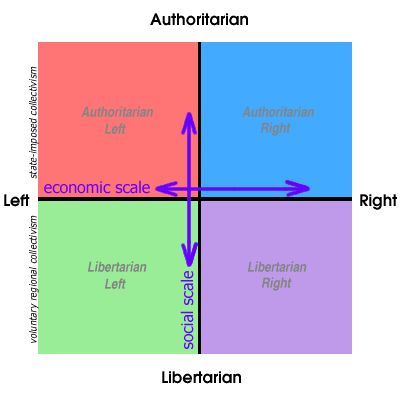
In response to such difficulties, alternative spectrums have been produced. In the late 60's David Nolan introduced a spectrum which simultaneously charted the  dimensions of economic and personal freedom: the most prolific iteration of which is "The Political Compass".

Pictured: The Political Compass (below left) and Nolan's chart (below right).


cartesian plane with horizontal left-right axis and vertical authoritarian-libertarian axis


While this twin-variable approach does help clear up the difference between libertarianism and conservativism, the underlying meta-theory is still lacking. Nolan's divide between economic and personal freedom reflects his own libertarian tendency to understand freedom from and freedom to as distinct categories - with the former taking moral primacy. Here freedom is reified and frustrated independently of one's economic means: your liberty can be obstructed by a tyrannical government but not by economic deprivation - this is only one way of understanding freedom.

Concurrently there is a problem as both The Political Compass' and Nolan assume that competing ideologies maintain converging ideas of what freedom and equality etc entail. Consider, for example, The Political Compass' analysis of anarchism:  

"The usual understanding of anarchism as a left wing ideology does not take into account the neo-liberal "anarchism" championed by the likes of Ayn Rand, Milton Friedman and America's Libertarian Party, which couples social Darwinian right-wing economics with liberal positions on most social issues."  - The Political Compass.

This places orthodox anarchism in the bottom left and "neo-liberal anarchism" in the bottom right. Such an approach misunderstands the disagreement between minarchists and anarchists as one over whether or not people should "share their stuff" and misses the fact that the two groups have very different ideas about what it means to be free. Libertarian leftists disagree with libertarian rightists because they do not consider the ideas of the libertarian right to be fit for promoting a fully "free" society - their economic differences inform their disagreements over the nature of libertarianism.

The problem facing any political spectrum then is the necessary assumption that political differences are mostly quantitative; which is troublesome considering that political questions are more often also about what a virtue is as well as how much of it we should have. Such spectrums, at best, chart the possibilities of pragmatic political alliance between various groupings but pedagogically do little to inform test-takers about how their beliefs relate to others.


Thursday, 25 February 2016

Notes on Free Speech


It's difficult to think of a golden era for free-speech in the world. This is puzzling when one considers how much of the rhetoric on the topic invokes an oncoming dystopia in which we lose our precious freedoms. Whether we are discussing the increase of government power to disrupt public protest or criticising rise of the social justice left and their programme of no plat-forming, both narratives subtly imply that there was a time when anyone was free to say anything and not face any consequences ever.
Of course, the "anyone free to say anything and not face any consequences ever" bit is somewhat farcical: which is probably why no one really defends it when pressed on it. As it stands, you have a right to say what you want but others do not have an obligation to offer you material support or withhold criticism from you and your works. Typically the philosophical framework that supports such an argument rests on a dichotomous public/private conception of society: freedom of speech is seen as a civil "public" right, an agreement between you and the government, not a private obligation between particular individuals or their institutions.
Regardless, it seems difficult to find any period of time where contentious artists didn't face attempts to ban or boycott their work and where protests were roundly tolerated with no foul play on the part of the police.  In light of the history of censorship it's important to view free-speech as a struggle, an ongoing questioning and drawing of boundaries, rather than a concrete liberty.  Free speech isn't a magical place that exists in the past and while we may be tempted to view it as a possible utopian destination for our future, this is a similarly questionable conception. The bulwarks against total freedom of expression - the right to say anything anywhere to anyone anytime and never face any consequences for it ever - are often far too reasonable or ingrained into the human psyche as to be banished conclusively.

To clarify, here are what I consider to be two core reasons for defending free speech:

Firstly it is, in a very basic way, central to any notion of ethical individualism or moral conscience. It's also methodologically encouraged by our need to have a full variety of conclusions available to us in order to the deliberate effectively. These two elements dictate how one normatively evaluates today's issues.
As noted earlier there is a sound philosophical argument for withdrawing support and denying a platform to positions or voices you disagree with. Of course this philosophical argument is nestled within the assumptions of classical liberal thought - and like many aspects of classical liberalism is somewhat short-sighted. While not engaging with or providing resources to one's opponents is not a direct interference with their freedom of speech, the methodological/epistemological reasons for promoting free-speech are forgotten here.  When a person or movement is no plat-formed the wider public and both sides of the debate are deprived of valuable dialogue.

 This argument - that freedom of speech includes dialogue not just expression - would seem to condemn the no-platform tactic out of the box.  This is not necessarily so. There are a plurality of valid and serious factors in need of considering when hosting any sort of contentious debate. In particular when one is hosting a debate where ideas that you find to be morally abhorrent are being expressed. 
A host must seriously consider whether the debate will make people feel threatened or perhaps provide unwanted publicity for a dangerous movement or idea. The simple truth is that not all debates are worth having: not even from a specific political perspective but from a simple concern for the well-being of others. For instance, there is plenty of room to debate the merits of various vaccination programmes and there is some duty to provide room for all sides of the argument but when the anti-vaccination movement raises its voice it is generally innocent children who suffer as a consequence of people buying into their rhetoric.

Outside of handing a megaphone to morally abhorrent or damaging opinions one must also consider whether there is really a debate to be had. Are physicists obligated, by the values of free-speech, to debate psychics? At what point does a crank perspective of reality or politics begin to warrant debating in the public arena?
We have never had un-interrupted freedom of speech and, so long as we are forced to take a pluralistic approach to evaluating the merits of a debate, we never will. The fundamental dynamics of censorship are still intact and it doesn't look like they will go away. So long as we recognise that there are cases in which debate is un-necessary or potentially harmful, a case by case approach is unfortuntely required. There will most definitely be cases in which the spirit of such an evaluation is perverted: cases where the debate or object of concern is warranted, benign but blocked due to an irrational fear that previous political and philosophical commitments might be shattered.

This may seem somewhat defeatist but we have to remember that the "say anything, anytime" alternative is a poor substitute. The values of free-speech can only be realistically sustained as part of a culture that can patiently take calculated risks and deal with the other ethical concerns that arise in the process of mediating a diverse culture. 


*Not least because a world in which a person's words can never be held against them would be severly dysfunctional to say the least.