Tuesday, 15 November 2016

On Democracy and Its Cynics: Reflections on Trump

The presidential election of the United States of America 2016 transpired just under a week ago and now every person of every sensible shade of political opinion is shaking their head in disbelief. Naturally, the electoral victory of such a ruinous candidate as Trump has resulted in some bitter reflection on the values and limitations of democracy (examples of this anxiety/bitterness in pre-election form are found: here and here). The criticisms now are largely the same as those raised in times of yore: most voters are ignorant and, in an electoral democracy, charismatic leaders will often outperform more competent candidates. These points are echoed throughout the history of political philosophy from Plato's Republic to the "elite theorists" of democracy of the 50's, and they are given plenty of air time in times of distress. It is then only natural that we see them aired once more.

                                     Image result for Trump business

We must remember that Trump is/was far from being a typical electoral candidate. He himself is/was a member of the American Aristocracy. While he has solidified his power over the American landscape through an electoral victory, he was always a wealthy and connected member of the American plutocracy nonetheless. Had there been no election to win, were the United States of America a Neo-Roman Republic or Empire, Trump would probably have ascended to power just as easily through Machiavellian real-politick. In the hypothetical alternative universe of the United States of Aristocracy, he would have assassinated and out-manoeuvred his rivals just as he stampeded them in our democratic one. Authoritarian organisations typically favour rather than stifle the Caligula-esque figures such as Trump, but what of technocracy: the rule of the competent and wise? Is technocracy not a suitable alternative model; one that could avert the horrors of capriciously unscrupulous demagogues, without providing a power structure that would enable the reign of tyrants?


Thankfully, most people in the west are inclined to agree with Churchill and his the summation of democracy as "...the worst form of government, except all those others forms that have been tried from time to time.". The paradoxical nature of our contemporary democratic cynicism is worth unpacking. We loath democracy's nominal flaws, even though we recognise that it has value. But what would we possibly replace it with? Voters are often uninformed and irrational but un-democratic leaders are rarely renowned for their reasonableness; and while demagogues may rise to power through electoral means, are such figures truly contained in more feudal or aristocratic societies?


The problem of technocracy, especially with regards to its conception in juxtaposition to democracy, concerns two key contentious claims which simmer beneath the surface.


First we must consider that technocracy and aristocracy are more closely related than we might first think. Aristocrats have always thought themselves to be technocrats - the literal translation of aristocracy is, after all, "rule of the best". The dialogues of western academies are mostly filled with the voices of rich, white men. A strategy of deferring policy decisions to relevant captains of research and industry would result in a very limited demographic being handed control; granted that demographic would be relatively well educated and worldly, but that has generally held true for all aristocracies whose histories are filled with examples of neglectful and myopic governance. This is not to say that a nominal technocracy would not be an improvement on aristocracy, but rather to add a pessimistic footnote that calls attention to the parallels technocracy and aristocracy share in struggling to provide fair and attentive governance.


Second, we must dispute the very foundation upon which the technocratic/democratic divide rests. The pursuit of competent governance is not antithetical to the pursuit of a fair and representative governing processes. It is my belief, based upon a flexible and serious consideration of democratic praxis, that the hunt for social equity in the realm of social and political organisation is a great enhancer to our collective efficacy. In this humanist age the function of good government - whether that is taken as the management of people or a more anarchistic "organising of things" - is to aid in the running of a society conductive to the pursuit of happiness and justice. This telos is both universal and implicitly egalitarian. A full consideration of all the interests of any given fragmented society is required for any chance at realising such an aim. Democratic channels foster diversity of opinion and provide the possibility of levelling differences in power. This is an often overlooked yet deeply important element of the democratic process and one which aids us in our technocratic desire for competent and informed decision making. Political questions are often value-laden and only amicably resolved after much representative dialogue and exchange of perspective. The cold expert-veto-technocracy outlined above may be effecient when handling questions of truth but it is limited in so far as questions of policy are frequently linked with more collaborative inter-social projects of discerning what is just and fair.


Yet despite this, to understand the call for greater involvement of expert opinion as an un-democratic or "extra-democratic" call is to be fooled into maintaining a limited view of what democracy could be. One that, as we will see, is pernicious in a philosophical sense and perhaps even spiritually harmful to the democratic project.


There are plenty of ways to integrate expert knowledge into democratic culture. Consider the "mini-publics" of the deliberative democrats: small groups in which citizens, chosen for their representativeness of the larger concerned population, gather together to make large-scale policy decisions after being briefed by experts and given space for collective reflection on the topic. Although major legislative bodies have been hesitant to trust these mini-publics, the qualitative research on the topic is very promising. Furthermore, models of Sortitive Democracy provide other promising avenues for incorporating professional and worldly expertise into the democratic process by making eligibility for particular roles subject to qualifications and experience in the relevant area of policy. Even the bog-standard electoral system can be tweaked to produce better informed voters by improving services which pertain to public education.
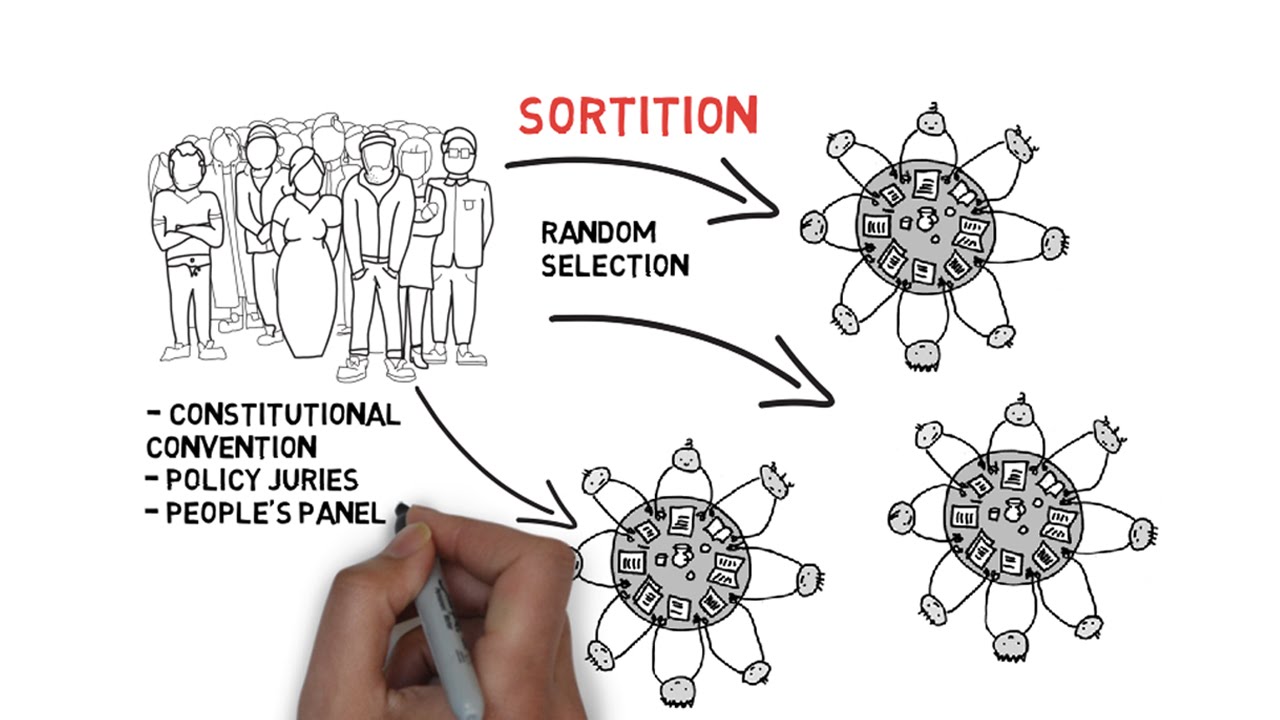

Image result for deliberative democracy Image result for sortition democracy


One might ask why I have bothered writing this post. After all, we all know that democracy really is the best of the worst, and none of us have any real desire to replace it. However I fear that our cynicism is both unwarranted and even dangerous. Democracy is not just a necessary arrangement to aid in the abatement of war-crimes and authoritarian collapse; it is a vessel which holds the seeds for a fairer and more intelligent world. Its invocation may not necessarily be a magical elixir to cure all ills, and it may require far more than a mere "going through the motions" to achieve anything worthwhile, but it is one of the moral zeniths of our modern age - however small, broken and disappointing it may seem to us now.


The ideals of democracy are far more institutionally flexible than they are often credited for. Democracy's core principles are firm, yet its praxis can easily be reworked to avoid the pitfalls of the dangerously populist and electorally obsessive systems of today. There are options for democrats who find the current formulations un-satisfactory; and there are steps that can be taken to improve and change it for the better. To portray democracy as a project doomed to produce Trump-like characters by way of unfortunate necessity is to limit our democratic sensibility and imagination: it is to tie our hands in the face of adversity rather than use this moment for reflection on the democratic failures of the current model and its attendant institutions.


In so far as Trump is a representative of an ignorant mass-hysteria coalesced around a cynical demagogue, he is also a representative of the deeply underdeveloped elements of American democracy. His triumph through the rallying of an un-communicative and ignorant public is but a indictment of the poor soil that has made up the substrate of U.S' voting public. In short, Trump is a poor leader in so far as he is the product of a poor democracy. The results of the 2016 election should not be a cause for empty despair at the supposed inefficacies of the democratic dream but rather a cause for reflection on the deeply under-developed potential of our democratic ideals and an affirmation of the steps that we must take to realise their humanistic, and even promethean, values.


Democracy is important: do not let the cynics discourage you.

Thursday, 13 October 2016

Selected Reading Reviews: 2015-16


A friend mentioned the use of vanity to motivate himself to read. The idea being that he regularly posts a list of books he has read, with short reviews accompanying them, in order to impress the internet and incentivise reading. It seems a perfectly good idea, so I thought I'd copy it. Fortunately I have been keeping a list of the books I have read, along with mini-reviews, for just over two years  now. Accordingly this post is an assortment of reviews for some of the good, bad and ugly books that I have read over the last two years. So, in no particular order...


Kitchen Confidential by Anthony Bourdain

A ground-breaking book in so far as it detailed the world of cheffing in juxtaposition to that of fine dining. Very honest but not entirely un-pretentious. Bourdain clearly revels in his mastery of the nomenclature of cooking and takes a childlike glee in revealing the seedy, crude and bleakly comical world of professional cookery to his presumably upper-middle-class clientele. It's as funny as it is insightful and for anyone wondering, as an ex-cook, I can confirm that it is mostly true.


Ariel by Sylvia Plath

Cutting and personal to the point of being cryptographic: such is modern verse libre. Lots of wonderful images and lovely mouth sounds: "the yew's black fingers wag" and "fat, gold watch". Initially intimidating on account of its obscurity but by the end I salvaged a few nuggets of poetic black gold.


One Hundred Years of Protest by Christopher Catherwood

A warning against what will happen to those who write about contentious subjects while trying not to upset anyone: in this case Catherwood ends up comparing Palestinians throwing rocks to rifle-fire from professional soldiers. This is done purely so that the author can preach the refrain "senseless violence on both sides".
Gandhi here is portrayed as an anti-racist (he wasn't) and a hard-line pacifist (again, nope) and the psychology of militant activism is boiled down to an expression of unreasonable outrage - despite the author holding Nelson Mandela (the leader of a terrorist organisation) in high regard. 


Why Fonts Matter by Sarah Hyndman

Interesting, accessible but about twice as long as it needs to be. Fonts influence us: they communicate as well as construct content and they have evolved alongside advances in culture and printing. I fully support Hyndman's goal in getting people to think about font more and her book makes for an adequate introduction to the subject - it's just a shame that this book isn't much more.  


Liberalism: A Counter History by Domenico Losurdo

The freedoms of the liberal world were hard won; universal suffrage and the abolishment of slavery were both contentious issues among the architects of the modern world. Losurdo's counter history reminds us of the theoretic possibility that was liberal freedom as the reserve of the privileged. Focusing primarily on the Atlantic slave trade, and also touching on the labour struggles of the developed west, Losurdo examines the philosophic acrobatics that were required to champion freedom during a time of great subjugation.  
The books thesis is rooted in an examination of the history of political struggle in early liberal society, its rhetoric and emergent conceptions of freedom. Of particular note is the idea that we could have freedom without equality and the small triumph of egalitarian struggle in helping correct that mistake.


The Philosophical Life by James Miller

The blurb of this book argues that it "confirms the continuing relevance of philosophy today". I have always been sceptical of such projects; especially when the philosophers the book points to are no more recent than Nietzsche. It would be much more prudent to prove the relevance of philosophy by pointing to the myriad of fascinating works published in recent years.
Perhaps what is meant by proving the relevance of philosophy, is its defence of philosophy as self-help - ala Alain de Botton. This is another project for which I have limited sympathy. Philosophy hasn't really operated with spiritual goals in mind for quite some time and I'm not entirely convinced that that is a problem. Even if enlightenment and happiness was the goal of philosophy I'm not sure this collection of mini-biographies makes a good case for the discipline. Seneca and Socrates were both murdered; Aristotle and Plato were widely ignored by the people they sought to tutor and Nietzsche and Kant died as pair of mad, tormented bastards. 
The book is still readable and informative, even if it doesn't achieve what it set out to do. Though there is one remark in the books conclusion worth expounding on: philosophers may face despair and madness ahead of them but they reason nonetheless. And we are all philosophers, by the very dint of being capable of thought.


4.48 Psychosis by Sarah Kane

A play that utilises an almost vers libre monologue to flit between moments of psychotic dread and sparkling gallows humour. Clearly written from a very honest emotional place, the clichés of mental health are steam-rolled into oblivion by Kane's candid and confused narrator. Intense, raw - must read again.


Hatred of Democracy by Jacques Ranciere

Ranciere explores the tensions of a secular republic and presents an understanding of democratic struggle as an expansion of public space in the face of technocratic elites. Modern political leaders must ape the values of democracy while simultaneously attempting to keep the populist masses at bay.
French, continental and as poorly written as it sounds. Like much of the post-modern canon it's 5% good ideas couched in post-modern verbage; an insightful analysis buried under a landslide of badly composed sentences with too many indexicals, needless ambiguity and a weird fetish for turning adjectives into proper nouns. Left me in many places feeling "the confused" and had me re-reading many passages two or three times over.


The Tinder Box by Hans Christian Anderson 

 Absurdly amoral fairytales seems to be HCA's thing. The Tinder Box is about a soldier who murders an old woman to steal her magic Tinder Box which gives him command of three magic dogs who help him commit regicide and marry the resulting orphaned princess. There are moments of humour here and there that make me think Hans Christian Anderson had adults in mind while also writing for children: the Deacon visiting the housewife in Little/Big Claus seems to be a wink and a nod towards more adult content.

Saturday, 1 October 2016

Book Review: Against Elections by David Van Reybrouck


"It would appear that the fundamental cause of Democratic Fatigue Syndrome lies in the fact that we have all become electoral fundamentalists, despising those elected but venerating elections. Electoral fundamentalism is an unshakeable belief in the idea that democracy is inconcievable without elections and elections are a necessarily and fundamental precondition when speaking of democracy. Electoral fundamentalists refuse to elections as a means of taking part in democracy, seeing them instead as an end in themselves, as a holy doctrine with an intrinsic inalienable value."

- Against Elections: The Case for Democracy, p.39.


The statistics on electoral participation in the first world make for a puzzling read. At a time where more people than ever live and vote in democracies, satisfaction is steadily dropping. What has gone wrong, and what is to be done? David Van Reybrouch, a radical democrat, thinks the problem lies in our reliance on elections and that the most feasible and effective fix is to be found in sortitive democracy. 

Sortitive democracy, for the uninitiated, is where positions of power and responsibility are assigned via random chance or "lottery". This lottery can take place among self-selected candidates or work by pooling from among a curated register. It can field qualifications such as "no children" or "must have experience or education relevant to the post" but it generally ensures an equal chance at power for all participants.

What are the advantages of such a system? Well, without elections, parliamentary members can focus on making decisions to the best of their ability. Curating an electable persona while in power is futile if your re-election chances are based, literally, on chance rather than public image and effective canvasing. The sortitive process also reduces the likelihood of demagogues acquiring power and the possibility of media savvy politicians outwitting more competent but less charismatic rivals. The disadvantages are surprisingly limited. While sortitive democracy limits the ability to veto characters who would otherwise never be elected, Reybrouck provides plenty of examples of how checks and balances can be implemented to limit the influence of unrepresentative winners- multiple chambers etc with veto powers and other tempering measures at their disposal.

The most obvious comparison for Reybroucks Against Elections is with David Graeber's The Democracy Project. Both aim(ed) to expand their readers understanding of what democracy could be and suggested alternate forms - although Reybrouck's book is the more detailed and moderate of the two. Reybrouck is clearly a parliamentarian. one who is best summarised as a liberal with some unorthodox ideas; although a radical democrat he is quite at odds with Graeber.

Notably, Reybrouck's treatment of other forms of radical democracy, namely anti-parliamentarianism, is curt and disappointingly vague.  For him the overly heterogenous processes of Occupy were its downfall and resulted in a movement unable to articulate a cohesive set of demands. This is in contrast to Graeber who takes Occupy's decentralised and democratic process to be the very thing that weathered the movement so long against the NYPD. But Reybrouck's critique feels unfinished, almost unattempted. The decentralised participation and consensus systems of Occupy are brushed off before they are even properly articulated and it would help his argument greatly if he provided a more comprehensive breakdown of why he suspects such systems are destined to fail.

Part of Reybrouck's critique of Occupy, and indeed his defence of parlimentarianism, is bundled up in the broadly asserted truism that anything of a revolutionary or anti-parlimentarian nature will necessitate brutality: the hard-core participatory democrats of Occupy are misguided and destined to become proto-stalinists in love with themselves and revolutionary terror. The difference between rejecting parlimentarianism in favour of revolutionary despotism and rejecting parlimentarianism because you are trying to articulate a kinder, less corruptible form of democracy is never acknowledged.

What is proposed towards the end of the book is a sortitive democracy that could temper the electoral system in the hope of one day replacing it. His rhetoric towards the end is hopeful. Although he thinks the current democratic systems are failing Reybrouck is confindent that Sortitive Democracy is a solid solution that has been proven work before, all it needs is a public and political class to believe in it enough to really commit.

Perhaps what is left unaccounted for is that a democracy with low participation and public trust, while dysfunctional, is not necessarily unstable. Academics often over-estimate the importance and timeliness of their solutions to macro-political problems of post-modernity. This is particularly true of radical democrats and other popular authors of the libertarian left.  But while Sortitive Democracy is one way of ameliorating the failures of electoral liberalism, that does not mean that the failures of electoral liberalism are bad enough to propel change. In a society where wealth plays a large role in determining political outcomes we must, cynically, ask whether its failures are serious enough to threaten the affluence of its most powerful members and force the status quo to reconsider itself.

Against Elections is an accessible book that contributes to the broadening of popular debate around the question of democracy, for that it should be thanked. It provides a fairly well-paced and considered critique of elections that help us ask whether our democratic ideals could mean something more than gritting out teeth whenever a demagogue finds themselves on the precipice of electoral ascension. Whether Sortitive Democracy itself is a salve for the paradoxical democratic deficit in the land/s of the free remains to be seen.

Thursday, 8 September 2016

Cut Throat's Third Quarterly Review of 2016


The final quarter of 2016 is upon us and it is time to retrospectively assess the second half of the year. My initial resolutions for 2016 can be found here, and June's "half time" review of those resolutions can be found here. On with the show...

1. Reading, Writing and Running.


Now that I have picked up Judo and MMA again I no longer have any need for running. My exercise regime splits my week into three rest days and four days of workout; this has been the greatest success of 2016's resolutions so far. Exercise has finally been properly integrated into my lifestyle with an intensity and purpose that makes it both efficient and fun. After spending nearly two years drifting around in limbo, I am finally back in shape.

Progress with both my writing and reading has been encouraging but inconsistent. Reading wise, I have managed to stave off the temptation to buy new books, and have gotten close to clearing my home libraries gargantuan back-log; writing wise, I have begun work on a novella and am enjoying the process of writing poetry. I have begun experimenting with the integration of reading and writing into my morning ritual, this has worked well so far.


2. Get Techie.

No progress here, and little intent to improve. Back in January I thought I had a relatively stripped down set of resolutions. Bizarrely, I didn't spot the folly in wrapping up "read more, write more and run more" under one heading while also expecting to learn computer programming and progress with my cookery at the same time. I have come to my senses and abandoned this resolution in order to better pursue the other two.


3. Get Foodie.


Most of this year in the kitchen has been spent honing the elementary crafts and skills of world cuisine. In particular, mastering simple dishes and processes to the point that I can guarantee a consistent level of quality in terms of homemade curry/pizza/stir-fry/grill meals/omletes etc.

I have also, since getting back into combat sport, moved onto a more calorically restrictive diet. This is less of a stumbling block than you would imagine. The crux of good cookery is in making mediocre things taste great; learning to cook and learning how to enjoy food, that isn't drowned in butter and animal fat, work surprisingly well as a complimentary set of practices.


Lessons Learned.


The maxim "Do Less, Achieve More" was uttered at the beginning of this year: I have only recently begun to take it seriously. Accordingly, I will not pick up any skills in computer programming this year and will focus on consolidating the progress I have made in other fields.

Another life lesson is that if you want to incorporate a new activity into your life you need to properly alot a time and place for it. For example, getting and staying in shape is now fairly easy. Every Monday, Wednesday and Friday I go to a training session where I can wrestle, puff and lurch myself through endless tai-otoshis and juji-gatames and go home knowing I have had a good evenings workout. After that, all I need to do is work one more exercise session into my weekly schedule and I have met my target.

It's a shame I won't pick up any tech skills but I really should leave it until I am finished working on other areas of my life. What I really miss is the opportunity to engage in an activity with marked cognitive benefits. Meditation appeals to me for similar - but still different - reasons, and would probably be easier to fit into a daily routine. Well... there is always next year.

Wednesday, 31 August 2016

Can Science Swallow Philosophy?


Why do people ask this question? More specifically, why is the prospect of replacing philosophy with science so exciting?

Image result for scienceImage result for philosophy

The most obvious answer is that science "works", and that it is difficult to say the same for philosophy. Not because philosophy is useless but because the contributions of philosophy are necessarily oblique. Philosophy provides a theoretical substrate on which useful stuff can be built. A sad consequence of this is that philosophy is rarely the knight in shining armour which raises living standards and/or puts man on the moon. By comparison, modern science has only been around for a couple of hundred years and since then has significantly boosted humanity's understanding and power over the world.  From this, rather naive, point of view it is understandable then that some might relish the thought of empirical annexation at the expense of philosophers.

You will be unsurprised to hear that I loathe this kind of the question. Primarily because it concieves of science and philosophy in a very wrongheaded way. The whole notion of a scientific takeover of  philosophical terroritory is nonsense.* Philosophy cannot be annexed by science, both because its territory is so qualitively distinct from that of science and because of how vital that rationalist terrotory is to science's progress. Try imagining, for example, the scientific method without Hume or Locke. In fact generally philosophers and scientists work quite well in applying their skills in eachothers fields.

Science cannot swallow philosophy, anymore than philosophy can swallow science. Neither evidence nor rationality can explain away one another. We are condemned to philosophise. But if philosophy and science cannot be sensibly put in competition - since they are co-dependent processes - then precisely what are the annexers proposing? I will be honest here: I do not know. Most of the proposed attempts at a scientific purge of philosophical issues, that I have seen are incredibly vague. Especially with regards to how science would actually deal with important philosophical issues. More often than not the proposed solution implies steamrollong over philosophical debates as though they were non-existent. Case in point, "The Moral Landscape" by Sam Harris.

Image result for moral landscapeImage result for sam harris moral landscape


In this book, which purports to provide scientific solutions to moral problems, Harris' shows us, among other things, that we can scientifically measure pain - provided we make the reasonable assumption that qualia can be mapped onto biology. This is quite an unimportant observation as far as ethics is concerned - although fans of Harris seem to think it has earth-shattering implications.

Why am I not similarly impressed? Because the actual philosophical questions of import: Should pain be the deciding moral metric? Why should we be moral? etc - are left totally unresolved by Harris' framework. In order to accept the argument that hurting animals is wrong I need to accept that pain is of moral import regardless of who/what feels it. The fact that we can measure and track the brain states of a pig, and compare them with that of a human, is quite irrelevent to the actual moral debate. "The Moral Landscape" is a book that discusses evidence for certain empirical questions of possible interest to philosophers. It is, however, not a vindication of noveua logical positivism. The philosophical questions, the ones which an ethical response is suppose to answer, are left relatiely untouched. In response to Harris I would refer him to his horseman peer Daniel Dennet and his remark that:

"... there is no such thing as philosophy-free science; there is only science whose philosophical baggage is taken on board without examination."

Philosophy is necessary; worse, it is inevitable. But that does not mean that "Academic Philosophy", one current reification of rational inquiry, is beyond methodological reproach. There are no doubt many academic philosophers who do not have enough of a grasp of science to be as useful as they could be. I am also as convinced that there are plenty of scientists not as au fait with the philosophy as they need to be in order to reason properly about the implication of their own research. In this respect I am all in favor of promoting science within philosophy as a way of resolving empirical questions that have an impact on philosophical issues, and promoting the role that philosophy plays in directing and understanding empirical research. What I do object to is the notion that philosophy and science should be understood as two parties in a turf war. Considering their intellectual codepedency, I see no benefit in waging civil war.

*Of course, there are cases of early philosophers attempting to answer scientific questions - Aristotle, for example - only to later have their questions answered by actual science. But this is more  a case of actual science swallowing early pseudo-science rather than a case of philosophy qua philosophy being pushed to the margins.