Sunday, 29 May 2016

Thoughts on: Feminism, Eudemonia and The Philosophical Life.


Modern philosophy is an academic institution, not a way of life. This contrasts with its earlier reification where academies were far more reminiscent of religious sects than they were modern universities. Early philosophers, like the Stoics and Cynics, lived in communities that pursued eudemonia, a state of being attained through practise as often as it was through contemplation. Modern philosophy, by contrast, takes place in specialised university departments and is abstract, highly disciplined - motivated by a pay-check.*

This split between modern and ancient philosophical practises is partly a product of modern philosophy's formulation within academia, and particularly its formation within the context of scholarly specialisation. The early-modern demarcation of Natural Philosophy from Mental Philosophy, that gave birth to modern science, gave cause for philosophers to specify their role in relation to the newly emerging sciences. This is where the tradition of Analytic philosophy comes in to play. The Analytic school, often ambiguously referred to as the hand-maiden to science, championed a detached methodology intended to work in tandem with modern empiricism. It was a school of thought that initially went hand in hand with logical positivism and ultimately weathered many of the same criticisms.  Modelling themselves on the impartiality of science, Analytic philosophers embraced a rationalist methodology that emulated scientific values and aesthetics. 

But Moral and Ethical Philosophy, in particular, produce a form of discourse that is decidedly partial. Ethics makes up a large chunk of philosophy both in the disciplinary form of "Applied Ethics" and in the earlier more holistic sense of  eudemonia. It is a subject that asks us to change the way we interact with the world, which is distinct from scientific endeavours which are decidedly descriptive. Just as science and religion are often thought to be irreconcilable, so too are science and normativity. Analytically influenced ethicists have traditionally tried to resolve this idealistic tension by offering a form of philosophy that reads more like the prouct of an advisory panel than it does the outpouring an empassioned exemplar of human virtue.

Of course, despite the professional gloss, there are a number of analytic philosophers who have a personal stake in the arguments they present. Of particular interest are the feminists and their radical off-shoots who promote the interrogation of our preconceptions and celebrate conscious personal change. The rhetoric and literature surrounding identity politics, for example, often calls into question our ability to freely and objectively perceive others. Scepticism as a way of life then returns. Are female writers producing art that is less universal, and therefore less popular, or is their work simply not taken as seriously? Do I like masculine activities because I'm a man, or because I've been socialised to prefer them?

Within modern feminist praxis, and we'll limit ourselves to feminism for now, there is a continuation of early personal and transformative philosophy. A mode of philosophising where participants are invited to change their behaviour and interrogate their own perceptions of the world in pursuit of justice. The older notion of philosophical community can also be found in the modern concept of the affinity group: a collection of individuals who form relationships on the basis of their shared political affiliations.

In this way, the modern intersectional left has inherited the practise of philosophy as a critical approach to good living. Continental philosophy also, particularly Foucault, seems to have a strong tradition of practising philosophy with the intent to liberate. Once again leftism is a big part of that tradition: if only because the philosophical outlook tends to lend itself better to political outsiders than it does to members of the establishment. Outside of this there is a small cottage industry of pop-philosophy writers who aim to keep the transformative tradition of philosophy alive without getting too political. Susan Neiman, a Kantian ethicist, wrote a great book that I reviewed on this blog a while back; Alain De Botton continues to peddle his "Ways philosophy will heal/change you" shtick but a more recent book that I read on the subject was Prof James Miller's "The Philosophical Life".

Miller's book is a series of mini-biographies of famous philosophers throughout the ages. It is presented in the hope that these biographies will help revive the notion of philosophy as a way of life. The book's blurb boasts that it, "confirm[s] the continuing relevance of philosophy today", but what's notable about "The Philosophical Life" is that the most contemporary philosopher dissected is Nietzsche - a man who died over a century ago.

There is a strain of transformative philosophy alive today, but I wonder if its ideas are too contentious to be marketable outside the sphere of politics. Perhaps this sanitisation of transformative philosophy is what drives the critics of de Botton?  Eudemonia is intimately connected to ethics which is frequently bound up in political struggle. Attempting to secularise eudamonia may be what makes De Botton's writing seem so hollow; after-all, once you forgo the critique of your politico-economic reality, what's left outside of curmudgeonly Michael Foley stoicism?


* Okay, that last one was mean-spirited even it was, economically speaking, true.

Tuesday, 26 April 2016

Spectrums, Assumptions and The Political Compass


The left-right distinction is a well-worn feature of our political lexicon: a schema that finds its roots in revolutionary France and has since been abstracted out of context to typify politics tout-court.

A modern reader might reasonably wonder whether such a spectrum holds up considering the shades of left and right available to us. In our post-Reagan/Thatcher era the Right is torn between its roots in classical conservatism and the modern libertarianism that has attempted to replace it. The Left, similarly, is as fragmented in theory as it has been in practise. Consulting the conventional left-right dichotomy, we find anarchists and marxists in the same camp as liberals. While one might try to defend such a grouping on the grounds that a sliding scale could be plotted between communism and liberalism, this falls in to the trap of typifying socialism as "welfarism on steroids" while still failing to explain how anarchists tessellate with the left.

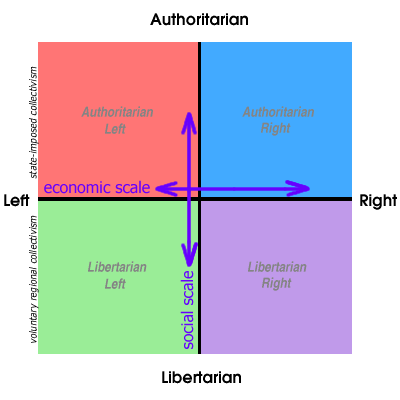
In response to such difficulties, alternative spectrums have been produced. In the late 60's David Nolan introduced a spectrum which simultaneously charted the  dimensions of economic and personal freedom: the most prolific iteration of which is "The Political Compass".

Pictured: The Political Compass (below left) and Nolan's chart (below right).


cartesian plane with horizontal left-right axis and vertical authoritarian-libertarian axis


While this twin-variable approach does help clear up the difference between libertarianism and conservativism, the underlying meta-theory is still lacking. Nolan's divide between economic and personal freedom reflects his own libertarian tendency to understand freedom from and freedom to as distinct categories - with the former taking moral primacy. Here freedom is reified and frustrated independently of one's economic means: your liberty can be obstructed by a tyrannical government but not by economic deprivation - this is only one way of understanding freedom.

Concurrently there is a problem as both The Political Compass' and Nolan assume that competing ideologies maintain converging ideas of what freedom and equality etc entail. Consider, for example, The Political Compass' analysis of anarchism:  

"The usual understanding of anarchism as a left wing ideology does not take into account the neo-liberal "anarchism" championed by the likes of Ayn Rand, Milton Friedman and America's Libertarian Party, which couples social Darwinian right-wing economics with liberal positions on most social issues."  - The Political Compass.

This places orthodox anarchism in the bottom left and "neo-liberal anarchism" in the bottom right. Such an approach misunderstands the disagreement between minarchists and anarchists as one over whether or not people should "share their stuff" and misses the fact that the two groups have very different ideas about what it means to be free. Libertarian leftists disagree with libertarian rightists because they do not consider the ideas of the libertarian right to be fit for promoting a fully "free" society - their economic differences inform their disagreements over the nature of libertarianism.

The problem facing any political spectrum then is the necessary assumption that political differences are mostly quantitative; which is troublesome considering that political questions are more often also about what a virtue is as well as how much of it we should have. Such spectrums, at best, chart the possibilities of pragmatic political alliance between various groupings but pedagogically do little to inform test-takers about how their beliefs relate to others.


Wednesday, 6 April 2016

Reconciliations: An Apology to Poetry


Just over a year ago I published a piece venting my frustration with the medium of poetry. I would like to announce a change of heart. After spending the last 12 months reading and writing poetry, in an effort to force myself to understand it, I have come to accept it as a necessary, even if sometimes dull, artform.

The aforementioned blog post is no longer available but its core contention can be distilled down to "poetry is too obtuse to be of any real value and we would lose little by jettisoning it from our culture". In hindsight it was foolish of me to even suggest that poetry could be done away with. It's musicality and rhythm come naturally to the human ear and the directness of vers libre would demand inventing, if it weren't already in existence. Indeed, although I was blind to it at the time, it was the giants of vers libre with which I took umbrage.

 Free verse is most notably what people refer to when they say they hate poetry; after-all few, my former self included, would begrudge the charm of conventional rhyme. And the vox-pop criticisms of free-verse are pretty close to the criticisms I wielded against it a year ago. Even Stephen Fry, a private poetry aficionado, shares my worries:

I think that much of poetry written today suffers from anaemia. There is no iron in its blood, no energy, no drive. It flow gently, sometimes persuasively, but often in a lifeless trickle of the inwardly personal and the rhetorically listless. This lack of anima does not strike me as anything like the achieved and fruitful lassitude of true decadence; it is much more as if the volume had been turned down., as if poets are frightened of boldness. - Fry, The Ode Less Travelled p.g. 325.

It is important to note that elsewhere in "The Ode Less Travelled", Fry expresses his love of T.S. Eliot: the grand-daddy of modern poetic crypticism. Fry doesn't fail to "get" modern poetry but he does worry for the effect of obscurantism on poetry's ability to say what is important.

Yet free-verse seems unusually predisposed to the introverted meanderings that Fry criticises. Such introspection is a by-product of free verses' directness which facilitates unmediated outpouring. This intense need to take what is inside and place it on paper is what makes the work of Plathe, or even the later plays of Sarah Kane, incomprehensible to someone with little biographical knowledge of the author. Such authors use free-verse techniques to encapsulate intensely intimate sentiments which most modern readers will struggle to unpack without the aid of contextualising references.

This particular style of free verse reflects the artist qua artist, which is why it is worth defending. It represents the legacy of conceptualism: art as a mode of expression and experimentation rather than as commodity or product of patronage. There are those who bemoan entitled art students who refuse to master their field and instead churn out conceptualist guff;  but perhaps it is the other way round. Perhaps the real entitlement lies with the on-looker who cries fraud when encountering art which doesn't speak to his interests or function within a familiar frame of reference. Defending this particular exercise in solipsistic free-verse by emphasising its artistic purity is to admit that while this kind of poetry has its place, it is far away from the limelight. But what of the more accessible, pleasing or otherwise extroverted poetry of Whitman, Shelley or Byron? Why are these forms of poetry not flourishing?

While I wish to avoid being dragged into the "Is poetry dead?" debate I think it's worth acknowledging how little poetry sales account for in the book trade. With this context in mind, poetry is often talked up as a much needed yet maligned hero fighting against a quick-fix culture. This seems somewhat rash. The contemporary era of the twitterati is one which is dominated by the succinctly written word. The memorableness, poignancy and sheer stick-ability of poetry should make it the perfect candidate to under-go a digital renaissance and yet it still remains a cultural outsider.

Perhaps the poetry industry has yet to recognise the potential of social media. Alternatively, the snobs might have a point. It may be that one of the joys of poetry is chewing over stanzas until they fall into place and its decline is due to a lack of slow-thinking engagement among modern readers. I hope for the sake of humanity that that is not the case and, whether poetry makes it to the centre stage or not, I wish it all the best.

Friday, 1 April 2016

First Quarterly Review of 2016


Time to reflect on the succeses and concessions of my fight against sloth and gluttony: welcome to Cut-throat and Clueless' Quarterly Review.

The Resolutions


1. Writing, Running, Reading.
Incorporating this augmented trio into an - almost - daily routine has been surprisingly easy. Writing wise I've produced a couple of radio plays and short stories that I'm very happy with - alongside some amateur ballads and free-verse poems of varying quality. Promisingly, exercise no longer reduces me to a pile of helpless splutters and has occasionally proved itself to be fun. However, on a less triumphant note, my reading has been slow this month due to a burn-out from all the heavy reading I did in January/February.

In the following weeks I'll adopt more body-weight orientated training and maybe start practising Judo or MMA again; in the meantime I'll continue writing and patiently wait for my reading appetite to recover.

2. Get Techie.
Nothing but stagnation on this front; once I clear some mental space I'll get right on to it... I promise.


3. Get Foodie.
Currently consolidating my efforts to hone some of my favourites meals; alcohol wise I have been sipping my way through variants of the Daiquri and found that Cachaça is an excellent full-bodied alternative to rum.

I used to do some great batch cooking - sauces, chutneys etc - and I'd like to return to it in order to perfect the method. There is something wonderfuly satisfying about handing a friend "a thing that you have made " which they can enjoy at their own leisure.

The Hit List


1. Video Games
This resolution has been an abject failure: I'm  playing Minecraft as I type this. Who'd have thought that an abstinence policy would backfire? 

2. Video Editing
A successful resolution in so far as I have not attempted to make any videos, however...

3. Misc
While I haven't picked up any new hobbies, I have continued trying to produce a little amateur humanities audio podcast. Time consuming, perhaps... but I think you'll find it's perfectly in line with this year's ethos: https://soundcloud.com/user-85578048